What Are Bone Guard Thermoforming Films? Complete Guide For Meat Packagers. If you’ve ever spotted a torn pack of bone-in chicken or a leaking rack of ribs in a retail cooler, you’ve already seen the problem that Bone Guard Thermoforming Films were built to solve. Sharp bones, jagged cartilage, and frozen protein corners are brutal on standard packaging – and a single puncture can turn a premium cut into a markdown, a customer complaint, or a costly recall.
For US meat and food packaging operations, that’s not a minor inconvenience. It’s lost product, wasted labor, and a hit to brand trust. This guide explains exactly what Bone Guard Thermoforming Films are, how they work, where they’re used, and why more packagers are making the switch.
What Are Bone Guard Thermoforming Films?
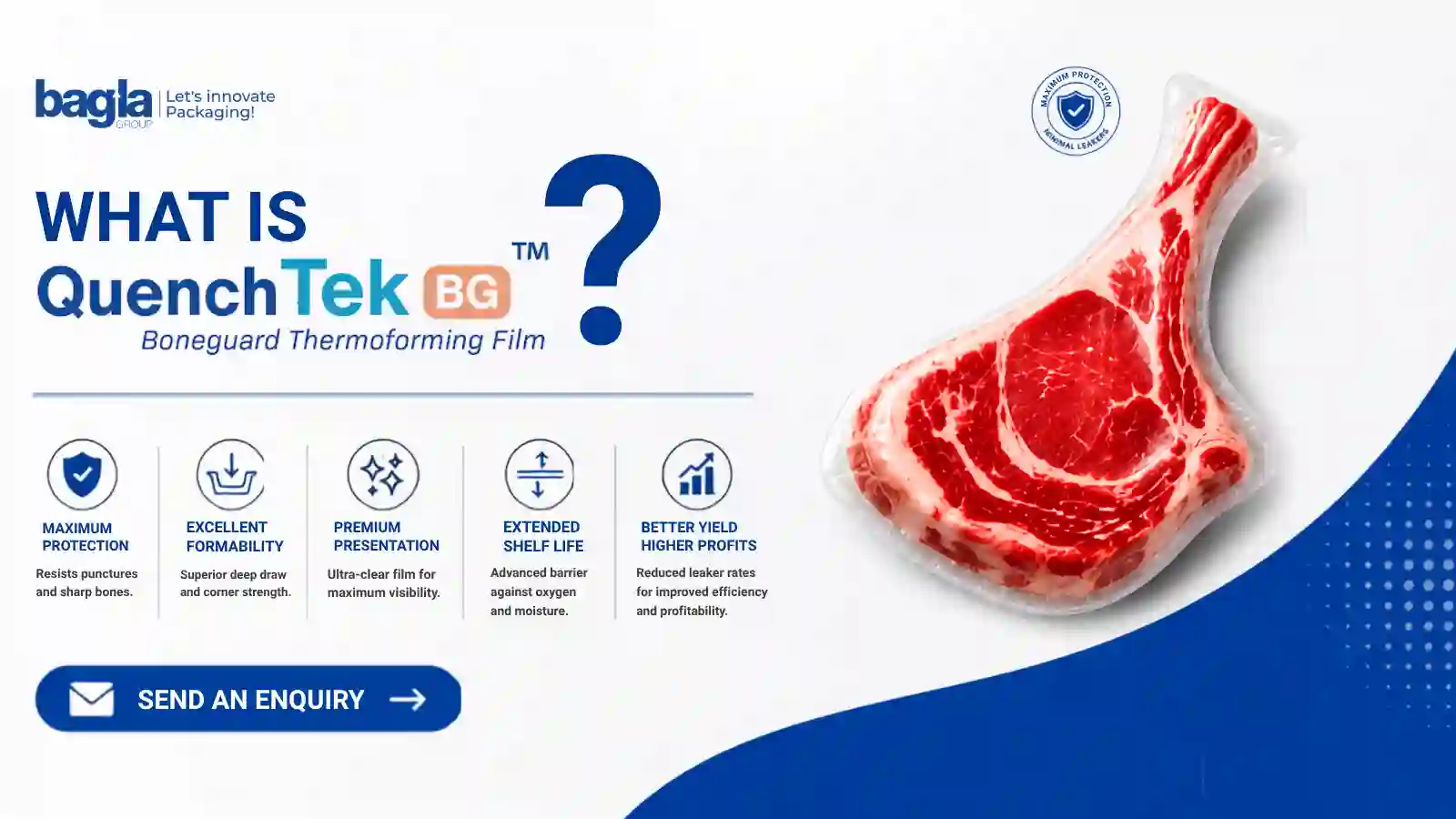
Bone Guard Thermoforming Films are high-strength, puncture-resistant forming films manufactured specifically for packaging products with sharp or irregular edges – bone-in meat, poultry, seafood, and other proteins that tend to damage ordinary film. In a thermoforming line, the film is heated and drawn into a cavity that cradles the product, then sealed with a top web to create a vacuum or modified-atmosphere pack (MAP).
What sets them apart from conventional forming film is their mechanical toughness. They’re formulated to flex around a protruding bone without splitting, so packs stay sealed from the production line to the retail shelf. In short, when standard film gives up, this is the material designed to keep going.
How Do Bone Guard Thermoforming Films Work?
The performance comes down to two things: the polymer structure and how the film is manufactured.
Most premium Bone Guard Thermoforming Films are built around a polyamide (PA) backbone, sometimes paired with an EVOH layer for oxygen barrier. PA gives the film its high puncture and impact resistance, while the barrier layers keep oxygen out and moisture in – the combination that protects color, flavor, and shelf life.
Just as important is the forming behavior. During thermoforming, the film has to stretch deeply into a mold without thinning out at the corners, which is exactly where punctures usually start. A quality film distributes material evenly so the formed corners stay thick and durable. That uniform distribution is what gives the finished pack its real-world strength once a bone presses against the inside wall.
The Technology Behind It | German Water Quenching
Not all forming films are made the same way, and the manufacturing process has a direct effect on how tough the final film is.
The strongest Bone Guard Thermoforming Films are produced using German Water Quenching Technology. Instead of cooling the extruded film with air, the process rapidly cools it in a controlled water bath. That fast, even quenching produces a finer, more uniform crystalline structure in the polymer, and that structure is what delivers higher toughness, better puncture resistance, and clearer optics. Water-quenched Thermoforming Films typically offer:
- Higher overall film toughness.
- Stronger resistance to punctures and impacts.
- Excellent optical clarity and gloss.
- More consistent gauge across the web.
- Reliable, repeatable thermoforming performance.
For a production manager, that gauge consistency matters as much as raw strength. Consistent film means fewer surprises on the line, more predictable forming, and a lower scrap rate run after run.
Common Applications for Bone Guard Thermoforming Films
These films were designed for the hardest packaging jobs in the protein aisle. Typical applications include:
- Poultry: bone-in chicken pieces, wings, and drumsticks.
- Red meat: bone-in mutton, lamb, beef cuts, and pork cuts.
- Fresh and frozen meat: where sharp frozen edges threaten the seal.
- Cured and processed meat: ham, bacon, smoked meat, and sausage.
- Seafood: fish with fins, shells, or sharp bones.
If a product has anything sharp on it — a rib, a wing tip, a frozen corner — it’s a candidate for Bone Guard Thermoforming Films. Plenty of US co-packers also standardize on them to reduce variability, running a single tough film across multiple SKUs instead of switching materials between lines.
Key Benefits for US Meat and Food Packaging
Here’s why packagers across the US are specifying these films.
- Superior puncture resistance: This is the headline feature. The films are manufactured to resist punctures from sharp bones and irregular edges, which is the number-one cause of pack failure in bone-in protein.
- Deep draw performance: For thicker cuts and bulk packs, you need a film that can form into deep cavities without weakening. Bone Guard Thermoforming Films handle deep draws while keeping material integrity intact.
- Stronger corners: Because the material distributes evenly during forming, the corners — usually the weakest point of any pack — come out thicker and more durable.
- Premium shelf appearance: Toughness doesn’t have to mean a dull pack. High gloss and ultra-clear transparency let the product sell itself, which matters in a US retail environment where presentation drives the purchase.
- Lower leaker rates: Fewer punctures mean fewer leaks during production, transport, and handling. That translates directly into less rework, fewer returns, and less product loss.
- Food contact compliant: The films are manufactured to meet food contact requirements, so they fit cleanly into a compliant packaging program.
Medium Barrier vs. High Barrier | Which Do You Need?
One of the practical decisions you’ll make is the barrier level, and Bone Guard Thermoforming Films are typically offered in two structures.
- Medium Barrier (PA-based): A polyamide structure suited to fresh meat applications where you need strong puncture protection and a reliable seal, but an extended oxygen barrier isn’t the priority. It’s a cost-effective fit for shorter shelf-life programs and faster turns.
- High Barrier (PA/EVOH): Adds an EVOH layer for a superior oxygen barrier. This is the choice when you’re extending shelf life, shipping longer distances, or protecting color and freshness in vacuum or MAP formats.
The right answer depends on your shelf-life target, distribution model, and the product itself. A short-shelf-life fresh cut sold locally has very different needs from a case-ready item shipped across the country, and matching the barrier to the application is where a good technical partner earns their keep.
Why Puncture Resistance Affects Your Bottom Line?
It’s easy to think of forming film as a commodity line item, but the math tells a different story. Every leaker carries a hidden cost, including the lost product, the labor to repack or dispose of it, the freight already spent, and the markdown or the unhappy shopper who won’t buy your brand again.
A film that fails even a few percent more often than it should can quietly erode margin across thousands of packs a day. Upgrading to puncture-resistant Bone Guard Thermoforming Films often pays for itself through reduced scrap and fewer customer claims, which is why many US operations evaluate film on total cost of ownership rather than price per pound alone.
There’s a food-safety angle too. A compromised seal is a contamination risk and a recall risk. Reliable Bone Guard Thermoforming Films help protect both the product and the brand standing behind it.
How To Choose A Bone Guard Thermoforming Film Supplier?
If you’re sourcing for a US operation, a few factors separate a dependable supplier from a risky one:
- Manufacturing technology: Ask whether the film is water-quenched. The process directly affects toughness and clarity.
- Consistent quality: Gauge consistency from roll to roll keeps your line stable and your scrap rate low.
- Customized structures: Your products, cavities, and machines aren’t generic, so your film shouldn’t be either. Look for a partner who can tailor the structure.
- Technical support: Real engineering help during qualification saves weeks of trial and error.
- Global supply capability: Reliable lead times and supply continuity matter when a stockout means a stopped line.
Bagla Group checks these boxes, manufacturing Bone Guard Thermoforming Films with German Water Quenching Technology in a state-of-the-art facility, backed by customized structures, technical support, and global supply capability.
QuenchTek BG · Bone Guard Thermoforming Film
Stop Paying For Packaging That Gives Up!
Put QuenchTek BG up against your sharpest bone-in products. Request a free sample and test the puncture resistance on your own line before you commit.
Why Choose Bagla Group for Bone Guard Thermoforming Films?
Bagla Group delivers high-performance QuenchTek BG Thermoforming Films designed for demanding meat packaging applications. Here’s what sets Bagla Group apart:
- German Water Quenching Technology for superior puncture resistance, excellent clarity, and uniform film strength.
- Customized Film Structures tailored to your product, machine configuration, draw depth, and shelf-life requirements.
- Medium & High Barrier Options, including PA/PE and PA/EVOH/PE structures for vacuum and MAP packaging applications.
- Exceptional Deep Draw Performance with uniform thickness distribution to strengthen vulnerable corners.
- Reliable Food Contact Compliance is manufactured to meet international quality and food safety standards.
- Consistent Roll-to-Roll Quality that minimizes downtime, reduces scrap, and improves production efficiency.
- Global Supply Capability backed by technical support from product selection through commercial production.
Note: Looking for other thermoforming film solutions? Bagla Group’s QuenchTek Series also includes high-clarity, high-barrier, medium-barrier, recycle-ready, peelable, and specialty thermoforming films designed for fresh meat, cheese, seafood, dairy, ready meals, and other food packaging applications.
Conclusion
For any operation packaging bone-in or sharp-edged products, the right film is the difference between a clean run and a steady trickle of leakers. Bone Guard Thermoforming Films bring together puncture resistance, deep-draw performance, premium clarity, and dependable barrier protection in one material, and the German Water Quenching process behind them makes that combination possible.
If you’re tired of writing off punctured packs, it may be time to test a tougher film on your line.