If you source Thermoforming Films for food, medical, or industrial packaging in the United States, you’ve probably run into the term Water Quenching Technology in a spec sheet, a supplier conversation, or a technical data sheet. It’s not a buzzword; it’s a specific manufacturing process that has a direct, measurable impact on the clarity, strength, and formability of the film running through your thermoforming line.
This guide explains exactly what Water Quenching Technology is, how it works, why it consistently outperforms conventional air-cooled film manufacturing, and what it means for US packaging companies sourcing Thermoforming Films for food, pharmaceutical, medical, and consumer packaging applications.
We’ll also walk through how Bagla Group manufactures Thermoforming Films using German coextruded Water Quenching Technology — and why that combination matters when you’re evaluating suppliers for your next packaging run.
What Is Water Quenching Technology?
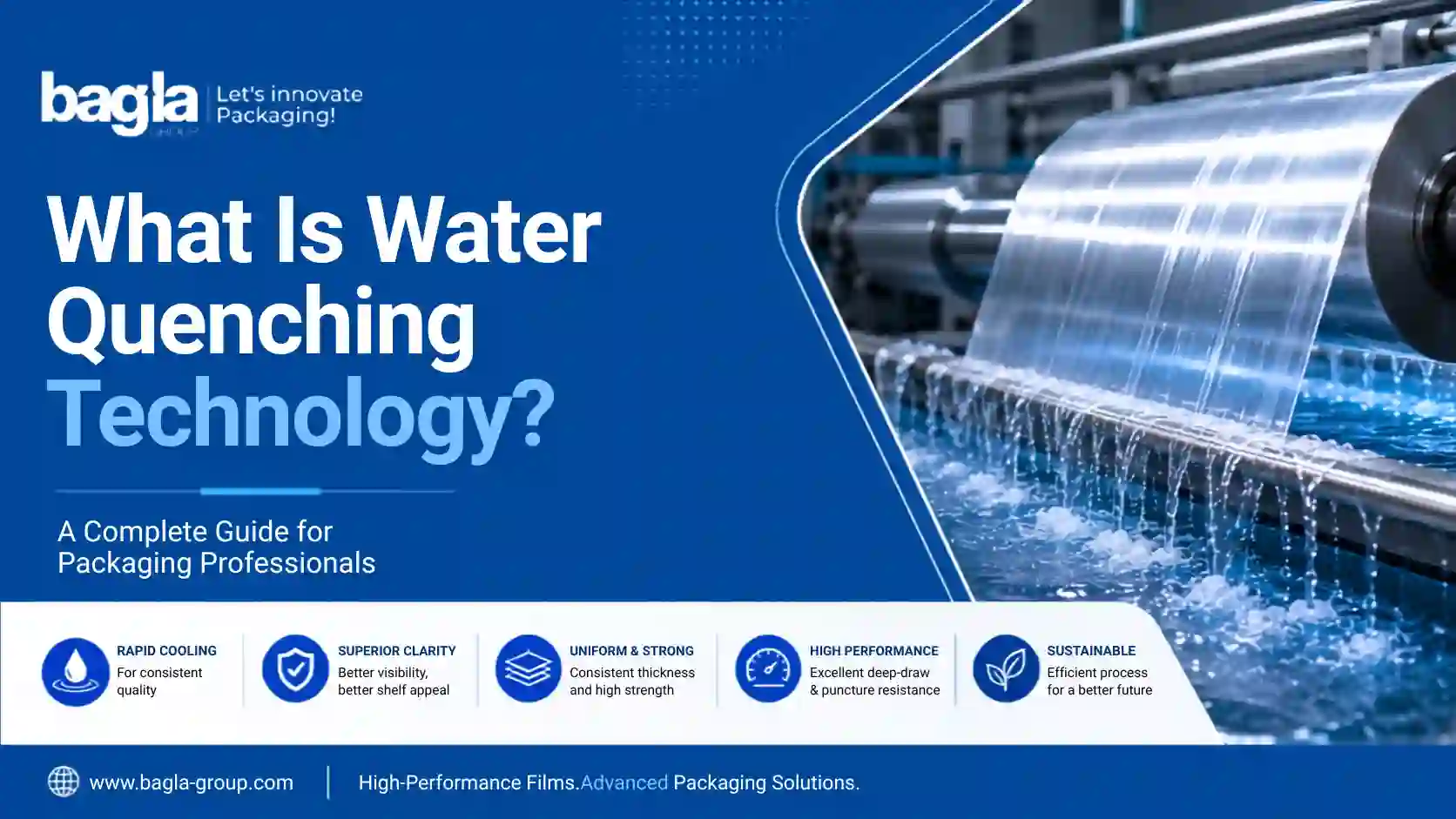
Water Quenching Technology is a film-cooling process used during the extrusion of Thermoforming Films, in which molten polymer exiting the extrusion die is rapidly cooled in a controlled water bath instead of being cooled gradually by ambient air or air rings.
That difference in cooling speed matters more than it might seem. When plastic cools slowly, its polymer chains have time to organize into larger crystalline structures. Larger crystals scatter light and stiffen the material unevenly, which shows up downstream as haze, inconsistent gauge, and films that crack or thin out unpredictably during thermoforming.
Water quenching interrupts that process. By pulling heat out of the film almost instantly and uniformly, it “locks” the polymer into a finer, more amorphous structure. The result is a Thermoforming Film with:
- Higher optical clarity and gloss.
- More uniform thickness (gauge) from edge to edge.
- Better puncture and impact resistance.
- Improved deep-draw performance during thermoforming.
- More predictable, consistent sealing behavior.
For packaging professionals, this translates into fewer line rejections, better shelf presentation, and packaging that performs consistently batch after batch — which is exactly what a plant manager sourcing film at scale needs to hear.
How Water Quenching Technology Works?
Water-Quenched Thermoforming Films are typically produced through a multilayer coextrusion process combined with a water-cooling stage. Here’s the process broken down:
- Resin Selection and Melting: Multiple polymer resins — commonly PE, PP, PA, EVOH, or PET, depending on the application — are melted separately, each contributing a specific functional property (strength, barrier, sealability, flexibility).
- Coextrusion: The molten polymers are combined through a coextrusion die into a single multilayer film structure in one continuous pass. This lets manufacturers build in oxygen barrier, moisture resistance, and seal integrity without laminating separate films together later.
- Water Quenching: As the film exits the die, it’s immediately drawn through a temperature-controlled water bath or over chilled water rollers. This rapid, even cooling solidifies the film before significant crystallization can occur.
- Gauge and Quality Control: In-line sensors monitor thickness and surface quality as the film cools, allowing real-time adjustments to maintain tight tolerances.
- Winding and Slitting: The finished film is wound into rolls and slit to the widths needed for downstream thermoforming lines.
Compared to air-cooled or chill-roll-only processes, water removes heat far more efficiently — which is why water-quenched films can achieve a level of clarity and consistency that’s difficult to replicate with air cooling alone.
Why Rapid Cooling Changes Film Performance?
Cooling rate is one of the most underappreciated variables in film manufacturing, but it drives nearly every property a packaging engineer cares about.
When films cool slowly (air cooling):
- Larger polymer crystals form, increasing haze.
- Gauge bands and thickness variation become more common.
- The film’s forming window narrows, making deep-draw applications riskier.
- Surface finish can be inconsistent, affecting print and seal quality.
When films cool rapidly and evenly (water quenching):
- Crystallization is minimized, producing a clearer, more amorphous film structure.
- Thickness stays consistent across the full web width.
- The film retains the flexibility needed for deep thermoforming without tearing or whitening at stress points.
- Mechanical strength and puncture resistance improve.
This is why Water Quenching Technology has become the standard for premium Thermoforming Films used in applications where clarity and reliability directly affect product marketability — particularly in retail food packaging, where consumers judge freshness by what they can see through the pack.
Water Quenching vs. Air Cooling: Side-by-Side Comparison
| Feature | Water Quenching Technology | Conventional Air Cooling |
| Cooling speed | Very fast, uniform | Slower, less uniform |
| Optical clarity | Excellent | Moderate to poor |
| Surface gloss | High | Standard |
| Gauge consistency | Tight tolerances | More variation |
| Deep-draw thermoforming | Excellent | Limited |
| Mechanical strength | Higher | Moderate |
| Line speed compatibility | Higher | Lower |
| Defect rate (haze, gels, uneven crystallization) | Low | Higher |
For US & European packaging companies running high-speed thermoforming equipment, the tighter gauge control and higher line-speed compatibility of water-quenched film often translate directly into fewer stoppages and less scrap — a real, measurable cost factor, not just a quality preference.
Key Benefits of Water Quenching Technology for Packaging Professionals
Outstanding Transparency and Shelf Appeal
Reduced crystallization means more light passes through the film cleanly, giving packaged products a premium, “you can see exactly what you’re getting” appearance — a meaningful factor at the retail shelf, where visual presentation influences purchase decisions.
Superior Deep-Draw Thermoforming Performance
Water-quenched films stretch more uniformly during forming, which reduces web breakage and thin spots — critical for cavity-style trays, clamshells, and blister packs that require significant draw depth.
Higher Mechanical Strength
Rapid, even cooling improves puncture and impact resistance, which reduces damage during transportation, distribution, and retail handling — an important consideration for companies shipping across the US distribution network.
Tighter Gauge Uniformity
Consistent thickness keeps high-speed thermoforming and packaging lines running smoothly, reducing machine jams, rejections, and material waste.
Enhanced Barrier Performance (via Coextrusion)
When combined with multilayer coextrusion, water-quenched films can incorporate barrier layers such as EVOH or PA to protect against oxygen and moisture — extending shelf life for perishable foods.
Faster, More Efficient Production
Water conducts heat away from the film far more efficiently than air, allowing faster line speeds and more stable production runs.
Supports Sustainability Goals
Because water-quenched films can be engineered with strong mechanical properties at lower gauges, manufacturers can often reduce material usage without sacrificing performance — supporting source-reduction goals that are increasingly important to US retailers and consumer brands.
Applications of Water-Quenched Thermoforming Films in US Packaging
Water Quenching Technology is used to produce Thermoforming Films across a wide range of packaging categories relevant to US manufacturers and co-packers:
- Fresh Food Packaging: Fresh and processed meat, Poultry, Seafood, Cheese and dairy, & Ready-to-eat and prepared meals.
- Vacuum and Modified Atmosphere Packaging (MAP) High-barrier, water-quenched films support strong seal integrity and gas-barrier performance, both essential for extending shelf life in vacuum-packed and MAP formats commonly used in US grocery and foodservice supply chains.
- Consumer and Retail Packaging Clamshells, rigid trays, and other point-of-sale formats benefit from the clarity and shelf appeal that water quenching provides.
Why German Coextruded Water Quenching Technology Matters?
Not every water quenching line delivers the same results. Process control, equipment precision, and engineering standards make a measurable difference in final film quality — which is why the equipment and process design behind water quenching matters as much as the technology itself.
German-engineered extrusion and quenching systems are widely recognized in the plastics industry for:
- Tight process tolerances and repeatability.
- Advanced temperature and gauge control systems.
- Reliable, high-uptime equipment design.
- Precision coextrusion die technology for consistent multilayer structures.
When water quenching is combined with German-engineered coextrusion, the result is a Thermoforming Film built on both a proven cooling process and a manufacturing platform designed for consistency at scale — which matters when you’re qualifying a film for a production line that can’t afford variability.
How Bagla Group Uses German Coextruded Water Quenching Technology?
At Bagla Group, we manufacture our Thermoforming Films (QuenchTek HB, QuenchTek MB, QuenchTek MBPP, QuenchTek BG & QuenchTek Mono) using advanced German coextruded Water Quenching Technology, combining precision German engineering with multilayer coextrusion and controlled water cooling.
This approach allows us to deliver Water quenched Thermoforming Films with:
- Exceptional optical clarity for premium retail presentation.
- Excellent deep-draw capability for cavity and tray-style packaging.
- Reliable seal integrity across a range of sealing systems.
- Consistent gauge profiles that run cleanly on high-speed lines.
- Designed barrier structures using PE, PP, PA, and EVOH layers, tailored to the shelf-life needs of the packaged product.
For US packaging companies, this means a film that qualifies consistently across production runs — reducing the trial-and-error that often comes with switching film suppliers.
Our team also works directly with customers to tailor film structures — layer composition, barrier level, and gauge — to the specific requirements of their product, packaging format, and thermoforming equipment.
What US Packaging Companies Should Look for When Sourcing Water-Quenched Films?
If you’re evaluating suppliers, a few questions can help separate genuinely high-performance water-quenched film from film that simply markets itself that way:
- What cooling process is actually used? Ask specifically whether the film is water-quenched or air/chill-roll cooled — the terminology is sometimes used loosely.
- What’s the layer structure, and does it match your barrier needs? Oxygen and moisture sensitivity vary widely by product category.
- What draw ratios has the film been tested at? This matters for deep-draw tray and clamshell applications.
- Can the supplier hold tight gauge tolerances at your required line speed? Ask for documented gauge variation data, not just marketing claims.
- Does the manufacturer have experience with your specific packaging format — MAP, vacuum, blister, clamshell, or otherwise?
- What quality and food-safety certifications does the manufacturer hold, and can they support compliance documentation for FDA-regulated or export packaging applications?
A supplier with real process transparency — willing to walk through their coextrusion and quenching setup in detail — is generally a good sign of manufacturing maturity.
Conclusion
Water Quenching Technology has become the manufacturing standard for high-performance Thermoforming Films because it directly addresses the variables packaging professionals care about most: clarity, strength, gauge consistency, and forming performance. For US packaging companies running high-speed thermoforming lines, the difference between water-quenched and air-cooled film often shows up on the production floor — in fewer rejections, cleaner runs, and packaging that consistently looks and performs the way it’s supposed to.
At Bagla Group, we build on this foundation with German coextruded Water Quenching Technology, combining precision engineering with multilayer film design to deliver Thermoforming Films that meet the demands of food, medical, and industrial packaging at scale.
If you’re evaluating Thermoforming Film suppliers for your next production run, talk to the Bagla Group team about how our water-quenched, coextruded films can perform on your line.
FAQs
What Is Water Quenching Technology?
Water Quenching Technology is a film manufacturing process where molten polymer exiting an extrusion die is rapidly cooled in a water bath rather than by air. The fast, even cooling reduces crystallization, producing Thermoforming Films with higher clarity, strength, and dimensional consistency.
How Is Water Quenching Different From Air Cooling Or Chill-Roll Cooling?
Water removes heat much faster and more evenly than air, which limits crystal growth in the polymer. This results in clearer, stronger, more consistently gauged film that generally performs better on high-speed thermoforming lines than air-cooled or chill-roll-cooled alternatives.
What Packaging Applications Use Water-Quenched Thermoforming Films?
Common applications include fresh meat, poultry, seafood, dairy, and cheese packaging, vacuum, and MAP packaging.
Why does German coextrusion technology matter for water quenching?
German-engineered extrusion and quenching equipment is known for tight process control and repeatability. Combined with multilayer coextrusion, it allows manufacturers to produce films with reliably consistent clarity, gauge, and barrier performance from batch to batch.
Does Bagla Group Manufacture Films Using Water Quenching Technology?
Yes. Bagla Group produces Thermoforming Films using German coextruded Water Quenching Technology, engineered for clarity, deep-draw performance, barrier protection, and consistent quality across production runs.
Is Water-Quenched Film More Expensive Than Air-Cooled Film?
Cost depends on the specific film structure, barrier requirements, and gauge — not the cooling method alone. In many cases, the reduced scrap, fewer line rejections, and ability to run thinner gauges with water-quenched film offset any difference in upfront material cost.