Asparagus is one of the most profitable yet most perishable items in the fresh produce aisle. From the moment spears are cut, they begin losing moisture, toughening at the base, and respiring at a rate higher than almost any other vegetable. For U.S. growers, packers, and retailers, that biology translates into shrinkage, markdowns, and discarded inventory. The good news is that smart packaging reduces food waste for asparagus by slowing these natural processes and protecting the product all the way from the field to the consumer’s refrigerator.
In this guide, we break down exactly why asparagus spoils so quickly, the mechanisms through which packaging reduces food waste for asparagus, and how high-performance Thermoforming Films from Bagla Group help U.S. packaging operations extend shelf life, cut shrink, and meet rising sustainability expectations.
Why Asparagus Spoils So Quickly?
Understanding the problem is the first step toward solving it. Asparagus presents a unique set of post-harvest challenges:
- High respiration rate: Asparagus respires faster than most vegetables, burning through stored sugars and accelerating quality loss within days.
- Rapid moisture loss: The tips and tender stalks dehydrate quickly, leading to wilting, shrivelling, and an unappealing limp appearance.
- Continued growth and lignification: Even after cutting, the base of the spear continues to toughen and turn woody, reducing the edible yield.
- Tip sensitivity: The delicate tips are prone to bruising, rot, and microbial spoilage when exposed to excess humidity or physical handling.
How Packaging Reduces Food Waste For Asparagus?
Packaging is not just a container; for fresh produce, it is an active preservation system. Here are the core mechanisms through which the right film helps packaging reduce food waste for asparagus.
1. Modified Atmosphere Packaging (MAP)
MAP works by adjusting the gas composition inside the pack, typically lowering oxygen and raising carbon dioxide to slow respiration. For a high-respiring vegetable like asparagus, controlling the internal atmosphere can dramatically slow metabolic activity and significantly extend shelf life. The film’s barrier properties and permeability are what make this controlled environment possible.
2. Moisture and Humidity Control
A film with the correct moisture-vapor transmission rate keeps the pack humid enough to prevent dehydration. At the same time, anti-fog properties stop condensation from clouding the pack or pooling on the tips. Maintaining optimal humidity is one of the most direct ways packaging reduces food waste for asparagus, because it preserves the crisp, plump texture shoppers look for.
3. Barrier Protection
High-Barrier multilayer films block oxygen and contaminants, slowing oxidation and microbial growth. By limiting the spear’s exposure to the elements, barrier packaging reduces food waste for asparagus and protects the bright green color that signals freshness at the point of sale.
4. Physical Protection
Tender asparagus tips bruise easily. A rigid or semi-rigid thermoformed tray cradles the spears, preventing crushing during transport and handling, two of the leading causes of in-transit and in-store loss.
5. Portion Control and Date Integrity
Right-sized packs help consumers buy and use only what they need, reducing household waste, while sealed, tamper-evident formats keep the product clean and extend usable life at home.
Thermoforming Films from Bagla Group | Designed for Fresh Produce
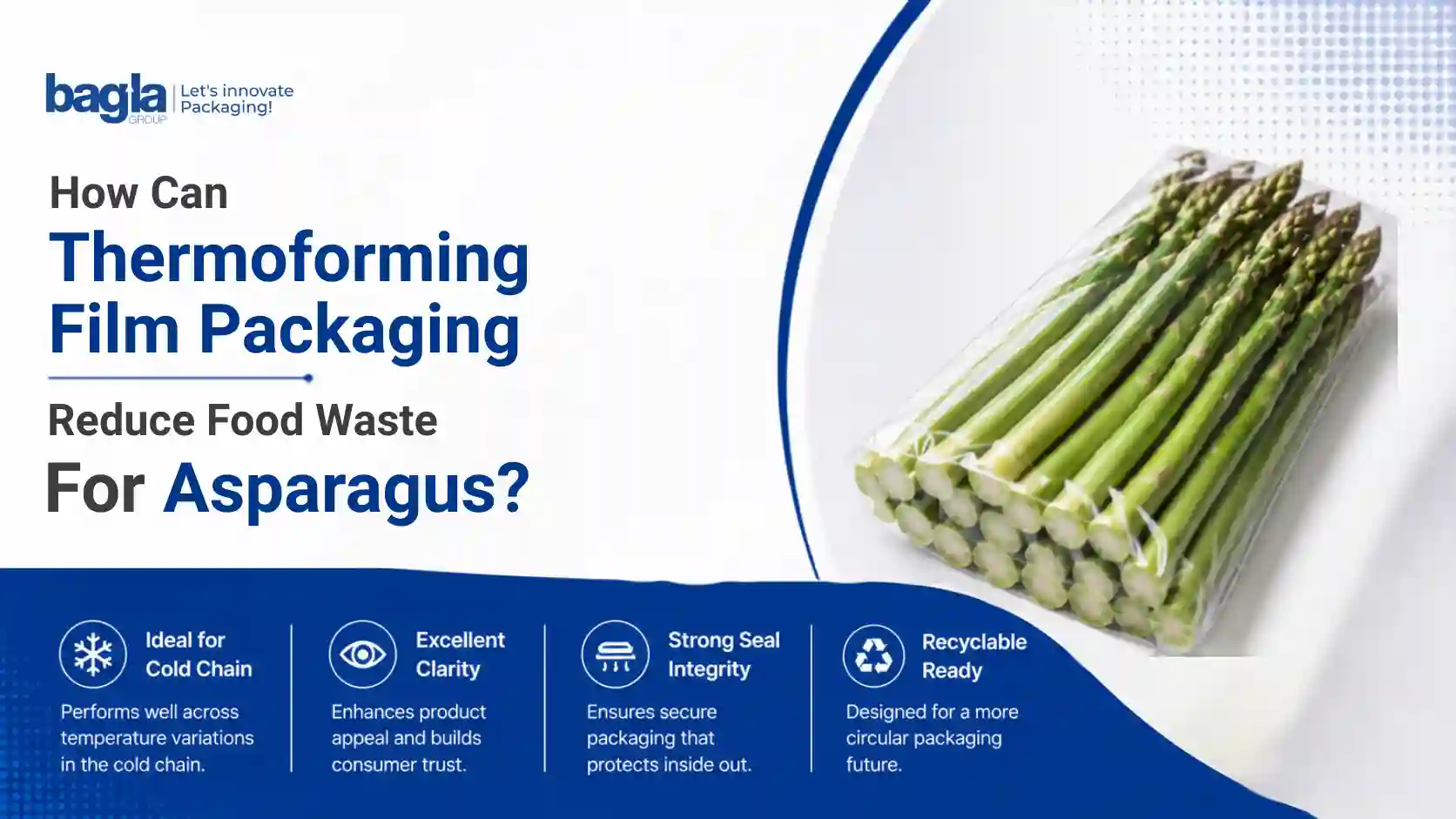
For U.S. packers looking to put these mechanisms to work, Bagla Group’s Thermoforming Films are purpose-built to keep delicate, high-respiring produce fresh. The range is anchored by the QuenchTek series, Bagla Group’s dedicated line of high-performance thermoforming films engineered for demanding fresh-food applications. These multilayer, co-extruded films are designed for the thermoforming process, in which a bottom (forming) web is heated and shaped into a tray or cavity, the product is placed inside, and a top (lidding) web is sealed over it. The result is a robust, attractive, fully sealed pack ideal for asparagus.
Key Specifications and Features
Bagla Group’s QuenchTek Thermoforming Films are offered as both forming (bottom) films and top/lidding films, and can be tailored to the demands of fresh produce:
- Multilayer co-extruded structures are manufactured for an optimal balance of strength, clarity, and barrier performance.
- Barrier and non-barrier options, including high-barrier EVOH-based constructions for oxygen-sensitive applications and breathable structures for respiring produce.
- Excellent formability and deep-draw capability allow reliable, consistent cavities even for taller spears without thinning or pinholes.
- High puncture and abrasion resistance to protect against punctures from cut stalk ends and to survive rigorous distribution.
- Anti-fog treatment to maintain crystal-clear pack visibility and prevent condensation on the tips.
- Peelable and weldable seal options for either easy-open consumer convenience or strong, leak-resistant hermetic seals.
- Compatibility with MAP and Vacuum Skin Packaging (VSP), enabling controlled-atmosphere preservation tailored to asparagus.
- Variable thickness/gauge options for forming and top webs, so converters can match film stiffness and barrier to the specific shelf-life target and machine setup.
- High-clarity, gloss finish for premium shelf appeal that showcases the product’s freshness.
- Printable surfaces suitable for high-quality branding, labeling, and date coding.
Why This Matters for the U.S. Packaging Industry?
For American packers and processors, the case for upgrading asparagus packaging is both financial and strategic.
- Reduced shrink and markdowns. An extended shelf life means fewer spears pulled from shelves, fewer markdowns, and more sell-through. Even a modest gain of a day or two in usable shelf life can meaningfully improve margins on a high-value crop.
- Stronger retail relationships. Retailers increasingly grade suppliers on freshness performance and waste metrics. Demonstrating that your packaging reduces food waste for asparagus helps secure and defend shelf space with major grocery chains.
- Sustainability and regulatory alignment. With state-level organic-waste diversion mandates expanding across the U.S. and consumer demand for lower-waste products rising, packaging that prevents spoilage supports broader sustainability goals. Less spoiled produce means fewer wasted growing inputs, water, and transport emissions, an outsized environmental win.
- Operational efficiency. Thermoforming runs on automated form-fill-seal lines that deliver high throughput and consistent pack quality, helping packers scale without sacrificing freshness.
Best Practices for Packing Asparagus to Minimize Waste
To get the most out of any film, packers should pair the right material with the right handling. A few practical tips:
- Cool fast, pack cold: Maintain the cold chain from harvest onward; packaging slows spoilage but does not reverse heat damage already incurred.
- Match the atmosphere to the product: Work with your film supplier to dial in the barrier and permeability that suits asparagus’s high respiration rate.
- Protect the tips: Orient spears so tips are cushioned, and choose a tray depth that prevents crushing.
- Seal with integrity: A consistent, leak-free seal is essential for MAP and VSP performance; validate seals regularly on the line.
- Right-size the pack: Offer formats that match how consumers actually use asparagus to cut household waste.
Followed together, these practices amplify the benefit and ensure packaging reduces food waste for asparagus at every stage, from the packhouse to the plate.
Conclusion
Asparagus rewards the packers who handle it well, and punishes those who don’t. Its speed of spoilage makes it a prime candidate for packaging innovation, and the evidence is clear that the right film does far more than contain the product. Through modified atmosphere control, moisture management, barrier protection, and physical cushioning, well-engineered packaging reduces food waste for asparagus while protecting margins, strengthening retail partnerships, and advancing sustainability.
Bagla Group’s QunchTek Thermoforming Films bring all of these capabilities together in formats built for high-speed U.S. packing operations. If your goal is to extend shelf life, cut shrink, and prove that your packaging reduces food waste for asparagus, the right film is the place to start.
Ready To Upgrade Your Asparagus Packaging?
Explore Bagla Group’s Thermoforming Films and talk to our team about a structure tailored to your shelf-life targets and production line.