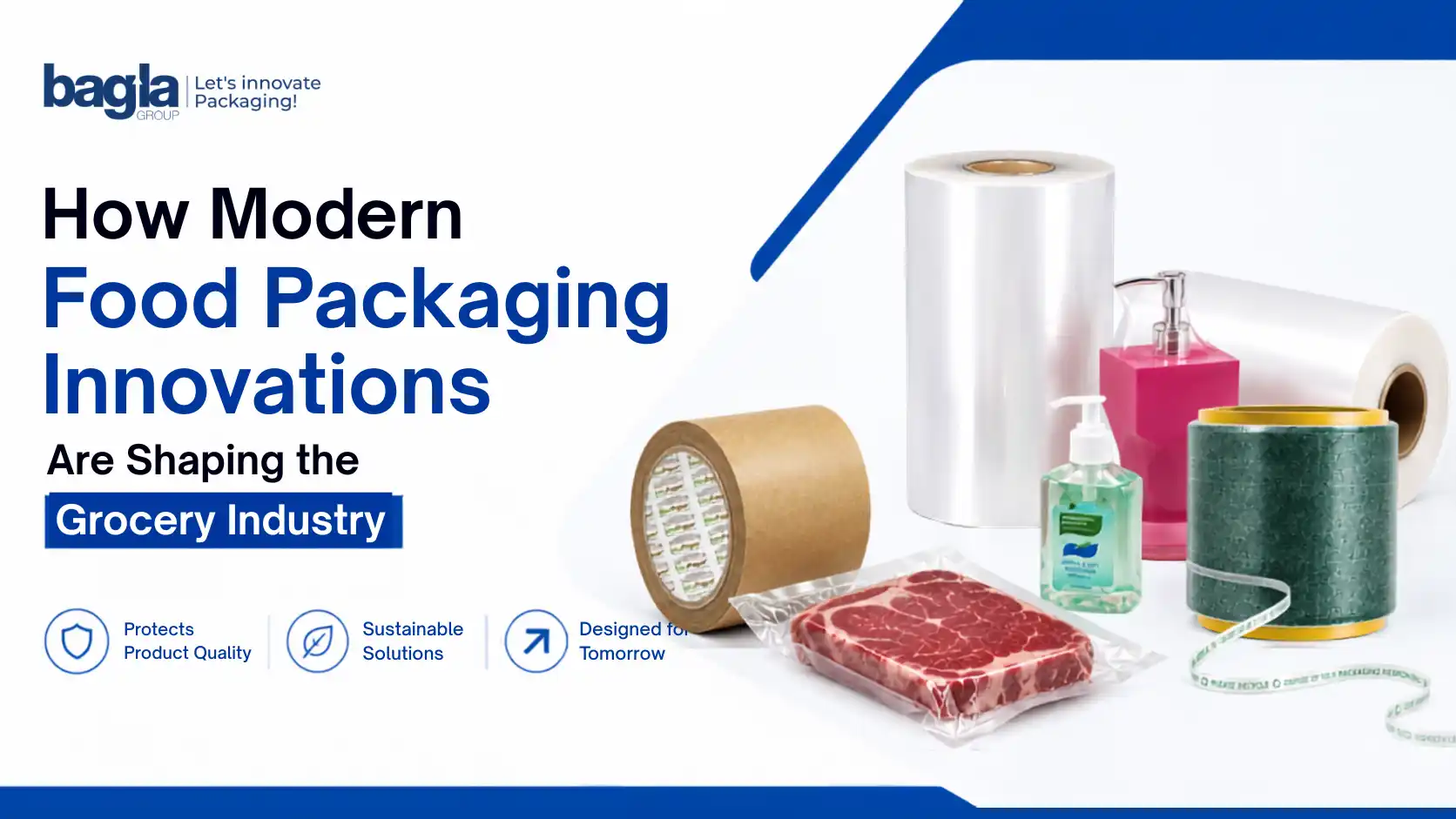
Modern food packaging innovations are redefining how grocery products are packed, protected, and sold. Tightening plastic regulations, rising consumer demand for recyclable packaging, and the industry’s shift toward sustainable food packaging solutions are all pushing this change forward. From mono-material films to advanced barrier technology, packaging formats that were standard a decade ago are being phased out fast, replaced by materials designed for both shelf performance and end-of-life recyclability.
For brand owners, converters, and retail buyers, these modern food packaging innovations are more than an industry trend; they directly affect which suppliers keep their contracts, which packaging formats meet compliance standards, and which materials will still be viable as plastic regulation tightens further. This guide breaks down what’s driving the change in grocery packaging, the key innovations reshaping the sector, and why mono-material Thermoforming Films — including those manufactured by Bagla Group- have become central to the future of recyclable food packaging.
Why Does Grocery Packaging Look So Different Now?
Understanding modern food packaging innovations starts with understanding the pressure packaging teams are under.
Packaging has always had a fairly narrow job: keep the product safe, look good on the shelf, and survive the trip from factory to store. That’s still true. What’s new is a fourth requirement that didn’t carry much weight ten years ago: proving the packaging is actually recyclable, not just labeled that way.
Retailers are being pushed on this from multiple directions at once. Regulators want compliance. Investors want ESG numbers that hold up. Shoppers, increasingly, are checking labels before they buy. All of that pressure lands on packaging teams, who now have to solve a genuinely hard problem: use less material, keep the barrier performance food needs, and make sure whatever’s left over can actually be recycled where it’s sold. This is the backdrop against which most modern food packaging innovations are being developed.
What’s Actually Driving the Shift?
Several forces explain why modern food packaging innovations are moving so quickly right now. A few of them are doing most of the work:
- Extended Producer Responsibility (EPR) rules across Europe, India, and several Asian markets, which financially penalize brands using non-recyclable, multi-material packaging.
- Plastic taxes and single-use restrictions that make lighter, mono-material formats the cheaper long-term option.
- Shoppers who now read recyclability labels before deciding what to buy.
- Public sustainability pledges from major grocery chains, many with hard deadlines attached.
- Food safety requirements that haven’t gone anywhere — fresh produce, dairy, and meat still need real barrier protection, or the product spoils.
- Straightforward cost pressure, since lighter materials mean lower freight and raw material spend.
None of these forces is new individually. What’s changed is that they’re all pulling in the same direction at the same time, which is why the industry has moved so fast on modern food packaging innovations compared to, say, ten years ago.
Top 6 Innovations That Are Actually Changing What’s on Shelves
Packaging is no longer just about protecting a product. Today, innovation is changing how products are packaged, transported, displayed, opened, and even recycled. Here are the top 6 innovations:
1) Mono-material structures
This is probably the single biggest shift among modern food packaging innovations happening in grocery packaging right now. For years, most flexible packaging was built from multi-layer laminates, PET bonded to nylon bonded to EVOH bonded to PE, each layer doing a different job. The problem is that almost no recycling facility can separate those layers back out. So even packaging that technically contains recyclable plastics ends up in a landfill or incineration because the materials can’t be sorted.
Mono-material films solve this by building the whole structure from one polymer family — usually PE or PP — designed in a way that still delivers the barrier and strength properties a multi-material laminate used to provide. Because it’s a single polymer, it can move through existing PE or PP recycling streams without special processing. That’s the difference between packaging that’s recyclable on paper and packaging that’s actually getting recycled.
2) Better-performing Thermoforming Films
Thermoforming — heating a film and forming it into rigid trays and tubs — hasn’t changed much as a process. What has changed is the film going into it. Newer Thermoforming Films, including mono-material ones, are being formulated to hold up against oxygen and moisture the way older multi-layer laminates did, without needing the mixed-material construction that made those laminates unrecyclable in the first place.
3) Lightweighting
One of the quieter modern food packaging innovations is lightweighting. Cutting film thickness without losing strength or barrier performance sounds minor, but it adds up fast at scale. Less material per unit means lower emissions in transport, less raw plastic consumed, and better numbers on whatever sustainability report a retailer is publishing that year.
4) Recycled content that doesn’t sacrifice recyclability
There’s a meaningful difference between packaging that contains recycled plastic and packaging that’s recyclable itself. The better innovations here manage both — integrating post-consumer recycled content while keeping the final film structure simple enough to go back into the recycling stream when it’s done.
5) Active and intelligent packaging
Among modern food packaging innovations, this category gets less attention but matters just as much. Oxygen scavengers, moisture absorbers, freshness indicators — these aren’t new ideas, but they’re being adopted more widely as retailers look for ways to cut food waste, which is its own sustainability metric now.
6) Simpler labeling and design for recycling
Fewer ink layers, mono-material labels, clearer on-pack instructions. Small changes, but they matter. A lot of “recyclable” packaging still fails because consumers or sorting facilities can’t tell what it’s made of.
Taken together, these are the modern food packaging innovations retailers and converters are actually budgeting for in the next few years.
Sustainable Innovations Across the Rest of the Pack
Recyclability pressure doesn’t stop at the tray — it extends to the shrink wrap, tape, and tear strips around it. Bagla Group’s wider portfolio brings the same “recyclability first” approach to these secondary packaging touchpoints.
1) WrapTek Earth (Recycled POF Shrink Film)
A cross-linked POF Shrink Film made with 60% recycled content (30% post-consumer recycled + 30% post-industrial recycled), certified by AENOR. It maintains the clarity and sealing performance grocery multipacks and retail displays need, while replacing PVC Shrink Film — which contains chloride and releases corrosive fumes during manufacturing and degrades into harmful components at end of life. WrapTek Earth is classified as a BO-PE mono-material at LDPE level 4, so it stays within existing recycling streams. It’s supplied across a wide range of gauges and widths, with cores and boxes made from 100% post-consumer recycled paper, and is used for retail displays, consumer goods, and promotional multipacks.
2) EkoPaper (FSC® Certified Paper Packaging Tape)
A paper carton-sealing tape made from FSC® Certified Paper (85gsm total thickness, 57gsm paper grammage), formulated with a rubber-based adhesive for strong adhesion across surfaces. It’s hand-tearable with an easy-unwind mechanism for manual use, and offers good printability for on-tape branding — an affordable, more sustainable alternative to plastic carton tape without giving up sealing strength.
3) EkoRip (FSC® Certified Paper-Based Carton Tear Tape)
A paper Tear Tape, also made from FSC® Certified Paper, built to let shipping boxes and envelopes be opened without any plastic film. It uses a synthetic rubber, pressure-sensitive adhesive on a 120 or 150 GSM paper backing, holds a reliable bond even on highly recycled board, and is repulpable — supporting fibre recovery rather than adding a plastic component to an otherwise paper-based carton. It’s suited to corrugated boxes, solid fibreboards, and mailers/envelopes, including thick single-wall and double-wall corrugated board, and is recommended for automatic production lines.
4) BOPP Acrylic Tape – Earth-30
A biaxially oriented polypropylene (BOPP) carton-sealing tape blended with 30% recycled material and coated with a water-based acrylic adhesive. BOPP Acrylic Tape delivers tack, clarity, and long-term adhesion comparable to virgin BOPP tape, while cutting embodied carbon and diverting plastic from landfill — a straightforward swap for brands that want to reduce the footprint of their case-sealing tape without changing line equipment or performance expectations.
Together, these products round out the picture: mono-material Thermoforming Films handle the product-facing pack, while WrapTek Earth, EkoPaper, EkoRip, and BOPP Acrylic Tape Earth-30 bring the same recycled-content, mono-material, or plastic-free logic to the multipacks, cartons, and shipping cases those products travel in. For a grocery brand or converter trying to hit a sustainability target across the whole supply chain, that’s the difference between fixing one packaging format and fixing the packaging system.
Why Mono-Material Films Keep Coming Up in This Conversation?
Most of the innovations above are useful on their own, but mono-material film technology is different because it fixes the recyclability problem at the source rather than patching it downstream. Multi-layer laminates were designed for performance first and recyclability as an afterthought, if at all. Mono-material films were built the other way around — recyclability first, without giving up the performance grocery packaging actually needs.
Bagla Group’s Mono-Material Thermoforming Film
As far as modern food packaging innovations go, this is one of the most practical to adopt. Bagla Group manufactures a mono-material Thermoforming Film specifically for brands and converters trying to move away from complex, hard-to-recycle laminates without giving up shelf appeal or barrier performance. It’s built around a single polymer base, structured for the demands of grocery categories that are unforgiving when packaging fails, fresh meat, dairy, produce, and ready meals. A few things worth knowing about it:
- Single-polymer construction: Built from one polymer family, so it fits into existing PE or PP recycling infrastructure rather than needing a specialized process most facilities don’t have.
- Purpose-built for thermoforming: Designed to form cleanly into trays, tubs, and rigid containers on standard equipment.
- Barrier performance that holds up: Designed against oxygen ingress and moisture loss, which is where a lot of lightweight or “greener” films fall short.
- Built for existing conversion lines: Formulated to run without requiring converters to overhaul their thermoforming equipment.
- Supports compliance work already underway: Helps brands align with EPR obligations and public recyclability targets without a total packaging redesign.
It’s used across fresh fruit and vegetable trays, meat and poultry packaging, dairy and cheese packs, ready-to-eat meal trays, and bakery or snack packaging that needs a semi-rigid or rigid format.
What Brands Actually Get Out Of Switching?
The case for adopting modern food packaging innovations like mono-material Thermoforming Films tends to come down to a handful of practical points:
- Compliance gets simpler, since EPR and plastic-tax exposure drops.
- Sustainability reporting improves, particularly around recyclability rates rather than just recycled content.
- Supply chains get less complicated, with one polymer type to source and quality-check instead of several.
- Consumer trust improves, since shoppers are increasingly skeptical of packaging that claims recyclability without proof.
- Costs stabilize over time, as regulatory penalties on non-recyclable multi-material formats keep climbing.
Where It Gets Harder?
Even the best modern food packaging innovations come with trade-offs. None of this is a clean switch, and it’s worth being honest about where the friction shows up.
Some legacy multi-layer laminates still outperform mono-material films on very long shelf-life products, the material choice has to match the food category, not the other way around. Converters need to validate a new film on their own equipment before assuming it’ll run the same as what they’re used to. And recyclability only means something where the recycling infrastructure to actually process it exists, a mono-material film is only as good as the system receiving it. There’s also a real upfront cost to requalifying packaging lines, even when the long-term math works out.
Working with a manufacturer that understands both the material science and the realities of running a thermoforming line, which is where Bagla Group’s experience comes in, tends to make this transition less bumpy than doing it in-house from scratch.
Where This Is Headed?
The next stretch of modern food packaging innovations will likely focus on closing the remaining barrier-performance gaps in mono-material films, expanding recycled content without compromising food-contact safety, and — probably the hardest part — actually building out the recycling infrastructure that makes all of this worth doing. Retailers are past accepting “recyclable” as a label; they want proof it’s being recovered.
For anyone packaging fresh food for grocery shelves, the practical takeaway is simple: mono-material film isn’t an experiment anymore. It’s becoming the baseline expectation — and increasingly, so are the recycled-content and plastic-free options now available for the shrink wrap, tape, and tear strips that go with it.
Conclusion
Grocery packaging is being rebuilt from the inside out, driven by regulation, retailer commitments, and shoppers who are paying closer attention than they used to. Of everything changing, mono-material Thermoforming Film is one of the few modern food packaging innovations that’s both scalable today and genuinely aligned with where recycling infrastructure is headed.
Bagla Group’s mono-material Thermoforming Film was built for exactly this shift — giving grocery brands a recyclable, performance-tested alternative to the multi-layer laminates that dominated the last generation of packaging. Alongside it, products like WrapTek Earth, EkoPaper, EkoRip, and BOPP Acrylic Tape Earth-30 extend that same sustainability logic to the shrink wrap, tape, and tear strips that complete the pack.
To look at specifications and applications, visit Bagla Group’s Thermoforming Films product page, or reach out to the team directly to talk through the right film for your line.
FAQs
They’re the newer materials, structures, and technologies- mono-material films, active packaging, lightweighting- being adopted to make grocery packaging more recyclable and food-safe at the same time.
Because they’re built from a single polymer, they can go through existing PE or PP recycling streams intact, unlike multi-layer laminates that most facilities can’t separate and process.
Yes, it’s designed specifically for that kind of demand, with barrier and strength properties suited to fresh produce, meat, dairy, and ready-meal trays, while staying recyclable through standard PE or PP streams.
No. While large grocery chains are driving much of the visible demand, converters and brand owners of any size face the same EPR and plastic-tax pressures, which makes these innovations relevant across the supply chain.
Yes. Products like WrapTek Earth (recycled-content POF Shrink Film), EkoPaper and EkoRip (FSC® Certified paper tape and tear tape), and BOPP Acrylic Tape – Earth-30 (30% recycled-content carton tape) apply the same recyclability and recycled-content principles to shrink wrap, carton sealing, and box-opening applications.