Walk down any seafood aisle in a U.S. grocery store, and you’ll notice something: almost every pack looks the same. Clear trays, generic labels, a thin film lid, and a “best by” date squeezed into the corner. For packaging material distributors and seafood brands trying to win shelf space, that sameness is a problem. If your product looks like everyone else’s, price becomes the only thing left to compete on — and that’s a race nobody wants to run.
Learning how to stand out in seafood packaging isn’t about flashy design alone. It’s about combining protection, freshness, sustainability, and shelf appeal into one package that does its job quietly and well. In this guide, we’ll break down what actually moves the needle for seafood brands and distributors, and why Thermoforming Films are becoming the go-to packaging solution for companies that want to lead rather than follow.
Why Is Seafood Packaging Harder Than It Looks?
Seafood is one of the most demanding categories in food packaging. Unlike shelf-stable snacks or dry goods, fresh and frozen seafood come with a unique set of problems:
- High moisture content that encourages bacterial growth and drip loss.
- Strong odor compounds that need to stay locked inside the pack.
- Sensitivity to oxygen exposure, which speeds up spoilage and discoloration.
- Short shelf life, especially for fresh, never-frozen products.
- Cold chain dependency, meaning packaging must perform at freezer and refrigerator temperatures without cracking or delaminating.
Any brand or distributor looking for a packaging material to stand out in seafood packaging to set a product apart has to solve these problems first. Consumers may notice a beautiful label, but if the fish smells off or the tray leaks in the fridge, that first impression is wasted. Function has to come before flash.
Key Strategies To Make Your Seafood Packaging Stand Out
To stand out in seafood packaging, focus on packaging that keeps products fresh, attracts customers, and reflects your brand. The right materials and design can improve shelf appeal, protect product quality, and encourage repeat purchases.
1. Prioritize Barrier Protection
The single biggest driver of seafood quality is barrier performance — how well the packaging blocks oxygen, moisture, and odor transfer. High-barrier films slow down oxidation and microbial growth, which directly extends shelf life. For distributors supplying processors and retailers, offering high-barrier film options is often the easiest way to add value without asking customers to change their entire packaging line.
2. Choose Materials That Support Freshness, Not Just Appearance
Modified atmosphere packaging (MAP) and vacuum skin packaging (VSP) have become standard tools for seafood processors because they replace oxygen-rich air with a controlled gas mix or pull the film tight against the product. Both approaches reduce spoilage and preserve color, but they only work if the film itself has the right barrier and seal properties. This is where material choice becomes a competitive advantage rather than a commodity decision.
3. Build in Transparency and Consumer Trust
Today’s seafood buyers want to see what they’re getting. Clear, crystal-clear film structures that let shoppers inspect color, texture, and portion size build more trust than opaque packaging with a printed photo. Combine that visual transparency with clear labeling — catch method, origin, sustainability certifications — and you give shoppers a reason to choose your pack over the one next to it.
4. Design for Convenience
Portion-controlled trays, resealable pouches, and easy-peel lidding films are no longer “nice to have.” Busy U.S. households want seafood that’s easy to store, easy to cook, and easy to reseal if they don’t use it all at once. Packaging that supports these behaviors gives brands a functional edge that’s hard to copy with design alone.
5. Lean Into Sustainability
Retailers and consumers are both pushing for recyclable or reduced-plastic packaging. Lightweight, high-performance films that use less raw material per pack without sacrificing barrier strength — enabling brands to market themselves as environmentally responsible while actually lowering material costs. For distributors, stocking recyclable-friendly film options is quickly becoming table stakes rather than a differentiator.
6. Stay Ahead of Food Safety Compliance
FDA regulations and HACCP guidelines for seafood are strict, and packaging plays a direct role in food safety compliance. Films with proven seal integrity, tamper-evidence, and documented barrier performance make it easier for processors to pass audits and maintain retailer relationships. Reliable compliance isn’t glamorous, but it’s a quiet way to build a reputation as a dependable supplier.
Why Thermoforming Films Are The Smart Choice To Stand Out In Seafood Packaging?
Of all the packaging formats available today, Thermoforming Films consistently check every box above — barrier performance, shelf appeal, food safety, and sustainability.
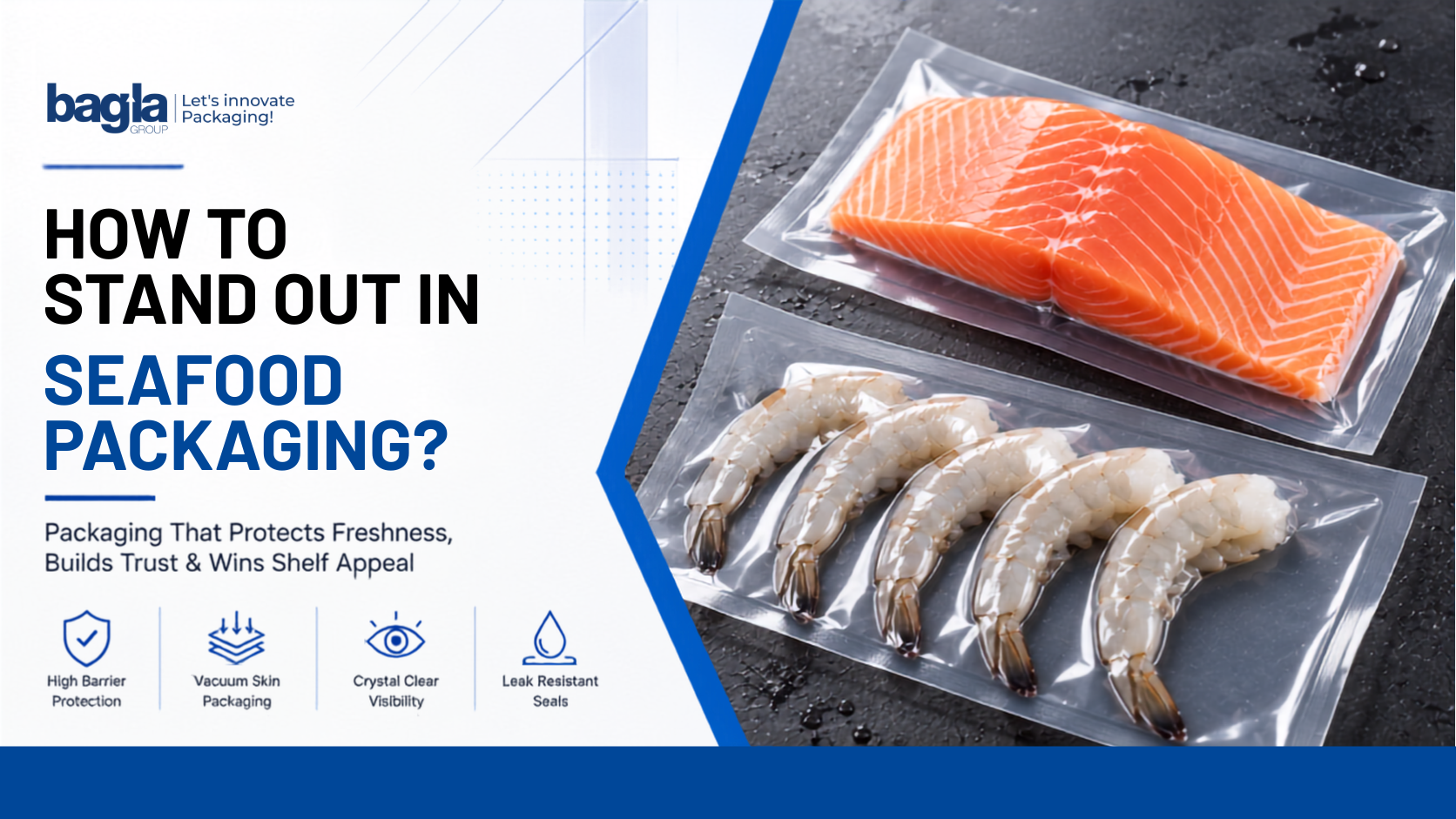
Thermoforming is a process where a flat plastic film is heated until pliable and then formed, using vacuum or pressure, into a custom tray or cavity shape around the seafood product. Once the product is loaded, a top web or lidding film is sealed on, often under vacuum or modified atmosphere. The result is a tightly sealed, form-fitted pack that hugs the product’s shape.
Here’s why Thermoforming Films are such a strong seafood packaging solution:
- Superior barrier protection: Multi-layer Thermoforming Films can be engineered with high oxygen and moisture barrier properties, directly extending the shelf life of fresh and frozen seafood.
- Custom, product-hugging shapes: Because the film is formed around the actual product, thermoformed packs reduce empty space, minimize movement during transport, and give shelves a clean, uniform look.
- Excellent seal integrity: Thermoforming produces strong, leak-resistant seals that are critical for preventing drip loss and cross-contamination — a must for seafood safety.
- Shelf appeal and clarity: Thermoformed film structures can be produced with high-clarity layers, letting the product itself sell the pack.
- Efficient material usage: Thermoforming Films can be down-gauged without losing strength, supporting sustainability goals while keeping costs predictable for distributors and processors.
- Compatibility with automation: Thermoforming lines run efficiently at scale, which matters for seafood processors managing high volumes and tight cold-chain timelines.
For packaging material distributors, Thermoforming Films offer a way to give processors a single solution that solves barrier protection, shelf life, presentation, and sustainability at once — instead of stitching together multiple materials to hit the same goals.
How Bagla Group Supports Brands That Want to Stand Out In Seafood Packaging?
At Bagla Group, we work with packaging distributors and food processors across the U.S. & Europe to develop flexible packaging films engineered specifically for demanding categories like seafood. Our Thermoforming Film solutions are built to deliver strong barrier performance, reliable sealing, and the clarity and shelf appeal that help products stand out at retail — while also supporting recyclable and down-gauged film structures for brands under sustainability pressure.
QuenchTek HB – Built for Seafood’s Toughest Demands
For seafood specifically, our QuenchTek HB High-Barrier Thermoforming Film is engineered for exactly this kind of demanding application. It’s manufactured using advanced water-quenching technology on our own Kuhne (Germany) quenching lines.
- Exceptional oxygen protection: Helps extend shelf life for vacuum-packed seafood traveling longer distances.
- Multi-layer co-extruded structure (PA, PE, EVOH, and other polymers): Delivers the mechanical strength and barrier performance that seafood packaging demands.
- High puncture resistance: Reduces spoilage and leakage risk during handling and cold-chain transit.
- Exceptional transparency: Keeps product visible and shelf-appealing at retail
- Ideal for deep-draw applications – Suited to a range of seafood pack formats and portion sizes.
QuenchTek Mono – For Brands Prioritizing Recyclability
For brands looking to reduce plastic use without giving up barrier performance, we also offer QuenchTek Mono:
- PA-free, high-barrier film built on a polyethylene base with an EVOH oxygen-barrier layer.
- Single polymer family structure: Supports mono-material recyclability goals.
- Suitable as a lower-footprint alternative for seafood brands under sustainability pressure.
Whether you’re a distributor looking to expand your film portfolio or a seafood processor evaluating a packaging upgrade, having the right Thermoforming Film partner — and the right film, like QuenchTek HB, makes the difference between packaging that just contains a product and packaging that actively sells it.
Conclusion
If you want your products to stand out in seafood packaging, it isn’t about chasing trends — it’s about mastering the fundamentals that matter most: barrier protection, freshness, transparency, sustainability, and compliance. Brands and distributors that get these right, using purpose-built materials like Thermoforming Films, put themselves in a stronger position on the shelf and in the cold chain alike.
If you’re ready to explore Thermoforming Film solutions for seafood packaging, reach out to Bagla Group to discuss the right structure for your product line.
FAQs
What makes Thermoforming Films better than standard shrink film or trays for seafood?
They form a tight, product-hugging seal rather than a loose overwrap — giving stronger barrier protection, better leak resistance, and a cleaner shelf look, all in one format.
What’s the difference between QuenchTek HB and QuenchTek Mono?
QuenchTek HB is a high-barrier, multi-layer film (PA/EVOH/PE) built for maximum protection. QuenchTek Mono offers similar barrier performance but is PA-free and single-polymer, making it more recyclable.
Can Thermoforming Films support both fresh and frozen seafood?
Yes, they’re built to perform across the cold chain, from fridge to freezer, without cracking or losing seal integrity.
Are recyclable or down-gauged films as strong as standard high-barrier films?
Yes. Films like QuenchTek Mono use less material but are engineered to hold the same barrier performance and strength.