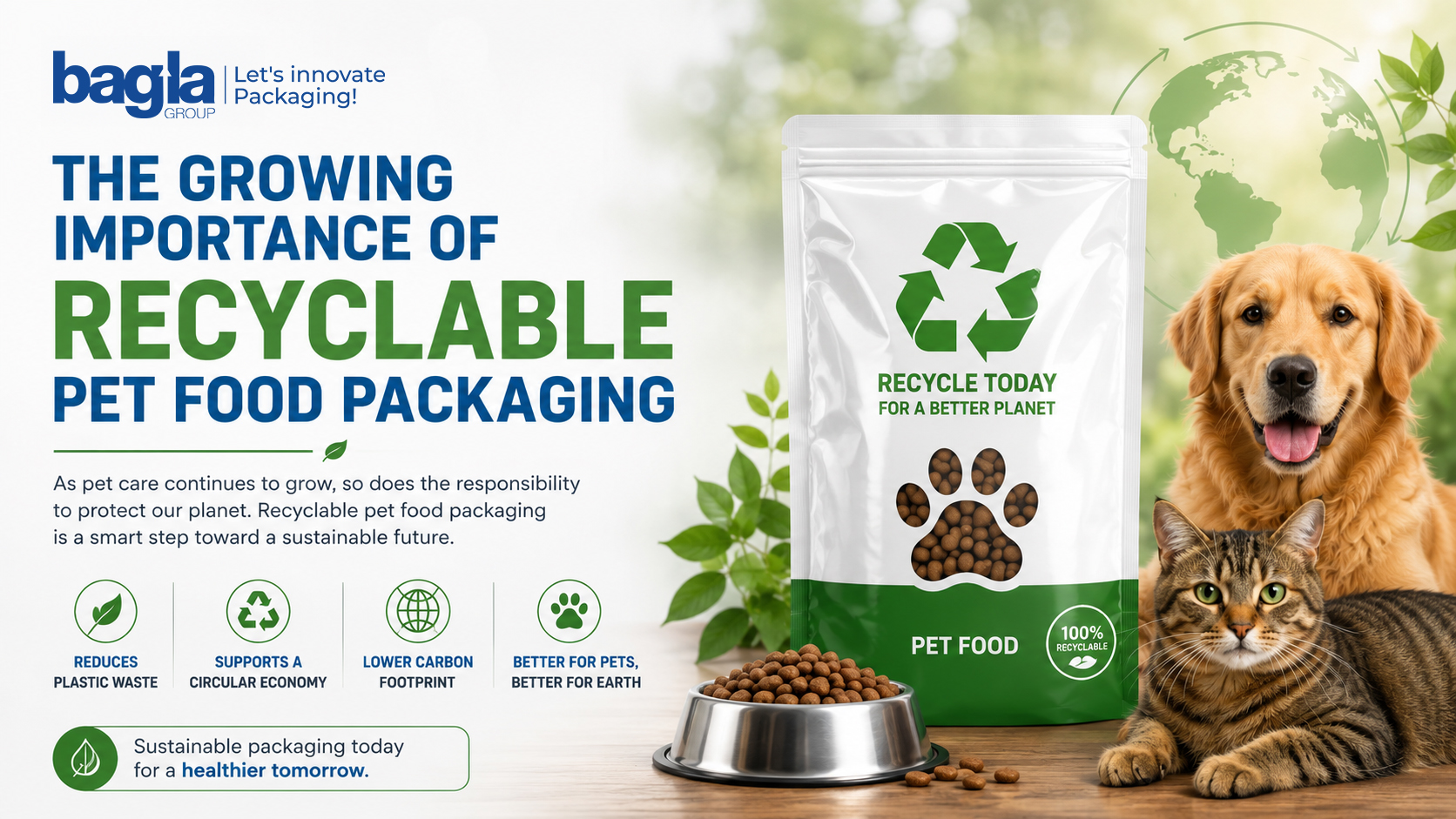
Pet food has quietly become one of the most competitive aisles in retail — and increasingly, the competition isn’t just about ingredients or price. It’s about what happens to the pack after the food is gone.
That’s a fairly new question for an industry that’s spent decades optimizing for shelf life, barrier protection, and print appeal. But pet parents are asking it anyway. They’re checking recycling symbols, questioning multi-layer pouches, and holding pet food brands to the same environmental standard they hold their own groceries to. A category once judged purely on nutrition is now also being judged on what it leaves behind.
That’s the backdrop for why recyclable pet food packaging has stopped being a nice-to-have and started becoming a real business requirement — driven by regulation, retailer expectations, and consumers who simply notice more than they used to. In this piece, we’ll look at why that shift is accelerating, why most of the packaging currently on shelves can’t actually be recycled, and what a genuine alternative looks like — including a mono-material film we’ve built at Bagla Group specifically to solve this problem.
Why Recyclable Pet Food Packaging Matters Now More Than Ever
A few years ago, “sustainable packaging” was mostly a line in a corporate responsibility report. Today, it’s showing up in purchasing decisions, retailer contracts, and government regulation — often all at once, and often faster than manufacturers expected. A few things are driving this:
- Consumers are paying attention: Pet owners increasingly research what their pet food is packaged in, not just what’s inside it. A pack that can’t be recycled doesn’t go unnoticed anymore.
- Regulation is catching up: Extended Producer Responsibility (EPR) rules are expanding across the EU, UK, India, and much of Southeast Asia, and they’re starting to apply real financial pressure to non-recyclable formats.
- Retailers are setting their own rules: Several major retail chains now ask suppliers directly about packaging recyclability before agreeing to shelf space; it’s become part of the negotiation, not an afterthought.
- Companies have made public promises: Many pet food brands have already committed to sustainability targets, and those commitments are meaningless without packaging that can actually back them up.
The Sustainability Challenge in Traditional Pet Food Packaging
Here’s the thing about pet food packaging — it has to work harder than most food packaging. Kibble needs oxygen and moisture protection to stay fresh for months. Wet food and treats are often greasy and need puncture-resistant films that won’t tear in transit. Seals need to hold under pressure, and the pack still needs to look good on a shelf next to a dozen competitors.
For decades, the answer to all of this was layering. Take a PET layer for structure, add aluminum foil for barrier, laminate on some polyethylene for sealability, and you get a pack that performs brilliantly. The problem only shows up at the end of its life. It’s a trade-off manufacturers made because, until recently, there wasn’t a practical alternative that delivered the same level of protection.
Why Multi-Layer Pet Food Packaging Isn’t Recyclable
Once you’ve bonded two or three different plastics together, there’s no practical way to pull them apart again. And that creates a chain of problems most consumers never see:
- Recycling facilities can’t process mixed-polymer laminates through standard streams; the different melting points and chemistries simply don’t cooperate.
- Even a small amount of the wrong material mixed into a recycling batch can contaminate the whole thing, ruining material that would otherwise have been perfectly recyclable.
- Brands using these structures are increasingly exposed to compliance costs as EPR fees rise for non-recyclable formats.
- And perhaps most damaging in the long term: a pet food brand that talks about sustainability while using packaging that can’t actually be recycled starts to look, fairly or not, like it’s greenwashing.
This is the exact gap that recyclable pet food packaging — specifically mono-material film — was built to close.
Mono-Material Packaging: The Recyclable Alternative to Multi-Layer Films
The concept behind mono-material packaging is almost refreshingly simple. Instead of combining several different plastics to get the performance you need, you build the entire structure from one polymer family (i.e., polyethylene (PE). Same material throughout, which means at the end of its life, it can actually go back into the recycling stream it came from, rather than getting rejected or landfilled.
What Is Mono-Material Thermoforming Film?
Thermoforming Film is the material used to create molded trays, pouches, and formed packs — the kind of packaging that needs to hold its shape as well as protect what’s inside. A mono-material Thermoforming Film does the same job that multi-layer laminates used to do, but without mixing polymer types to get there.
For pet food brands, this changes the conversation entirely. Instead of choosing between “packaging that performs well” and “packaging that’s actually recyclable,” you get both in the same material. That trade-off that’s defined the industry for years starts to disappear.
QuenchTek Mono: Bagla Group’s Recyclable Thermoforming Film for Pet Food Packaging
This is exactly the problem we set out to solve at Bagla Group. QuenchTek Mono is our mono-material Thermoforming Film, developed specifically for manufacturers who want to move to recyclable packaging without giving up the performance their products depend on.
Rather than layering multiple polymers together, QuenchTek Mono is built on a single-polymer platform (PE) designed to run on standard thermoforming lines and hold up to the demands of real pet food applications — not just perform well in a lab.
Key Features Of QuenchTek Mono Thermoforming Film
- Genuine mono-material construction: Built from one polymer family, so it can be processed through existing PE recycling infrastructure rather than being rejected by it.
- Barrier performance that holds up: Engineered to protect against oxygen and moisture ingress at levels comparable to traditional multi-layer laminates, so nutritional quality isn’t compromised.
- Compatibility with standard thermoforming equipment: Designed so converters don’t need to overhaul their lines just to make the switch.
- Resistance to punctures and grease: Built with wet food and fat-rich treats in mind, not just dry kibble.
- Reliable seal strength: Because a leak-proof pack matters just as much for recyclable packaging as it does for anything else.
- Print-ready surface quality: Sustainability shouldn’t mean giving up shelf appeal, and it doesn’t have to.
Why Pet Food Brands Are Switching To QuenchTek Mono?
For pet food manufacturers, QuenchTek Mono means being able to make a recyclability claim and actually stand behind it — not a vague “recyclable in some facilities” disclaimer, but something closer to the truth. It also means less exposure to tightening EPR regulations, fewer headaches during packaging audits, and a much smoother path toward genuine circular packaging, without needing to redesign a pack from scratch.
Benefits Of Recyclable Pet Food Packaging For Brands
Switching to recyclable pet food packaging isn’t purely a sustainability decision; it has real commercial consequences too, some of them fairly immediate.
- It builds trust in a category where trust matters a lot. Pet owners tend to see their pets as family, and that emotional weight carries over into how they judge the brands they buy from. Visible, genuine sustainability efforts tend to earn real loyalty here, not just polite approval.
- It gets ahead of regulation instead of scrambling to catch up. As EPR schemes expand, the cost of using non-recyclable formats is only going to climb. Brands that switch now are avoiding a scramble later.
- It strengthens retailer relationships. When a retailer asks about packaging recyclability — and increasingly, they do — having a real answer instead of a vague one makes negotiations easier.
- It’s often more cost-efficient than expected. Because mono-material films can frequently run on existing thermoforming equipment, the switch doesn’t always require the capital investment brands assume it will.
- It gives marketing something true to say. In a category where greenwashing accusations are becoming more common, being able to back up a sustainability claim with an actual recyclable structure is worth more than any tagline.
- It simplifies life-cycle reporting. More brands are being asked, by retailers or auditors, to document the environmental footprint of their packaging from production through disposal. A mono-material structure is far easier to trace and report on than a laminate combining three or four different inputs — one of the practical, often-overlooked advantages of recyclable pet food packaging when compliance deadlines are involved.
How To Choose The Right Recyclable Packaging Partner
Not every “recyclable” claim in this industry means the same thing, and it’s worth being a little skeptical when evaluating suppliers. A few questions worth asking:
- Does this supplier have real, demonstrated experience with mono-material films — or are they newly rebranding an existing product?
- Can they show actual barrier performance data (OTR, MVTR) rather than general assurances?
- Can they produce at the volumes you actually need, consistently?
- Will they work with your team through trials and line compatibility testing, or just hand over a spec sheet?
- Do they have documentation that aligns with the recycling and EPR standards relevant to your markets?
Bagla Group has spent years in flexible packaging manufacturing, and that experience is exactly what makes conversations about switching formats less risky — we’ve seen where these transitions go wrong, and we build our films to support brands moving confidently toward recyclable pet food packaging.
The Future Of Sustainable Pet Food Packaging
It’s fair to say the pet food industry is at a turning point. Regulations are tightening, consumers are paying closer attention, and recyclable packaging is quickly becoming the baseline expectation rather than a competitive edge. Brands that make this shift early are the ones who’ll avoid last-minute regulatory scrambles, who’ll be able to make sustainability claims that actually hold up, and who’ll be part of building the kind of circular system — where materials are recovered and reused rather than thrown away — that the whole industry is eventually going to need.
Mono-material Thermoforming Films are one of the most practical ways to get there. Not a distant, theoretical solution, but something brands can actually implement now.
There’s also a knock-on effect worth mentioning: as more converters and recycling facilities see steady volumes of mono-material packaging coming through, the infrastructure to handle it well only gets stronger. Early adopters aren’t just benefiting themselves — they’re helping build the recycling ecosystem that the rest of the industry will eventually depend on too.
Conclusion
The growing importance of recyclable pet food packaging says something bigger about where consumer expectations are heading. It’s no longer enough to protect what’s inside the pack — companies are now being asked, implicitly or directly, what happens to the pack itself once it’s empty.
Mono-material films like Bagla Group’s QuenchTek Mono offer a genuinely practical way to answer that question — giving pet food manufacturers the barrier protection and shelf performance they’ve always needed, while finally making the recyclability claims on their packaging something they can stand behind.
If you’re exploring this transition, the QuenchTek Mono is a good place to start, or you can reach out to our technical team directly for a more specific conversation about your application.