Nowadays, consumers are becoming more conscious of food safety, shelf life, and environmental impact. Packaging technology must rise to meet these evolving demands. Polyolefin (POF) Shrink Film is a material that checks many of these boxes.
It is versatile, food-safe, visually appealing, and suitable for both high-volume manufacturers and small-scale producers. Whether you need to wrap a chocolate bar or a bundle of water bottles, Shrink Films are one of the most reliable choices in the food industry.
Here, you will learn about polyolefin (POF) Shrink Film and how it can be used in food packaging.
What Is Polyolefin (POF) Shrink Film?
POF (Polyolefin) Shrink Film is an eco-friendly packaging material made from polyolefin resins, including Linear Low-Density Polyethylene (LLDPE). It shrinks tightly around products when heat is applied, due to the contraction of its polymer chains.
Known for its high clarity, strength, and flexibility, POF shrink film enhances product appearance while providing reliable protection, making it widely used across various industries.
How Does POF Shrink Film Work?
The process of using POF Shrink Film in food packaging involves 4 major steps:
- Wrapping: The product is wrapped in the film using a different machine, such as L-bar sealers, manual sleeve wrappers, or high-speed flow wrappers.
- Sealing: The film is heated to form a complete wrap around the product as per the product’s shape.
- Shrinking: It is passed through a heat tunnel (or subjected to a heat gun) where the film contracts, forming a tight, protective layer.
- Cooling: Once it cooled, the film gained its new shape, creating a tamper-evident, appealing package.
This simplest integration of automation and film behavior is one of the biggest reasons POF is widely used in the food production industry.
Why Is POF Shrink Film Used In Food Packaging?
If you are looking for a reason why the POF Shrink Film is used in the food packaging industry, then read the points mentioned below:
- Regulatory Compliance: The FDA, EU, and other global bodies approve the food-grade POF films. This indicates that they are safe for direct contact with a wide range of food types.
- Shelf Life Enhancement: Proper sealing increases shelf life by reducing contamination, oxidation, and moisture loss. It can be used with Modified Atmosphere Packaging (MAP) for sensitive items.
- Eco-friendliness: It supports the environment and can be recycled in Category 4 or 5 plastics streams (check with local facilities).
- Excellent Branding Opportunity: These Shrink Films allow for complete visibility of the food product. They can be printed with logos, QR codes, or promotional designs that are impressive for the consumer and help with branding.
- Cost Efficiency: Though initial material cost may be higher than PVC or PE, its strength and yield (more packages per roll) make it more cost-effective over time.
Key Properties of POF Shrink Film
The main properties of POF Shrink Film are as follows:
| Property | Description |
| Clarity | For excellent product visibility, it provides high gloss and transparency |
| Shrinkability | Across the surface, it shrinks up to 70% uniformly |
| Strength | Tear-proof & puncture-resistant, especially in multi-layer grades |
| Flexibility | Maintains integrity under cold storage, refrigeration, and some freezing conditions |
| Sealing Compatibility | Excellent hot-tack sealing with various machines |
| Thickness Range | Available in 50, 60, 75, 100, 120 Gauge & (12, 15, 19, 20, 30 μm) |
Types Of POF Shrink Film
At Bagla Group, POF Shrink Films are available in multiple variants designed for different packaging needs:
- Non-Cross-Linked Shrink Films: It is a type of multi-layered shrink film that offers the perfect balance of cost-efficiency, clarity, and ease of use. These films are made without any kind of irradiation or chemical processing. This will make it simpler and more economical & ideal for small and medium businesses or fast-moving consumer goods (FMCG) segments.
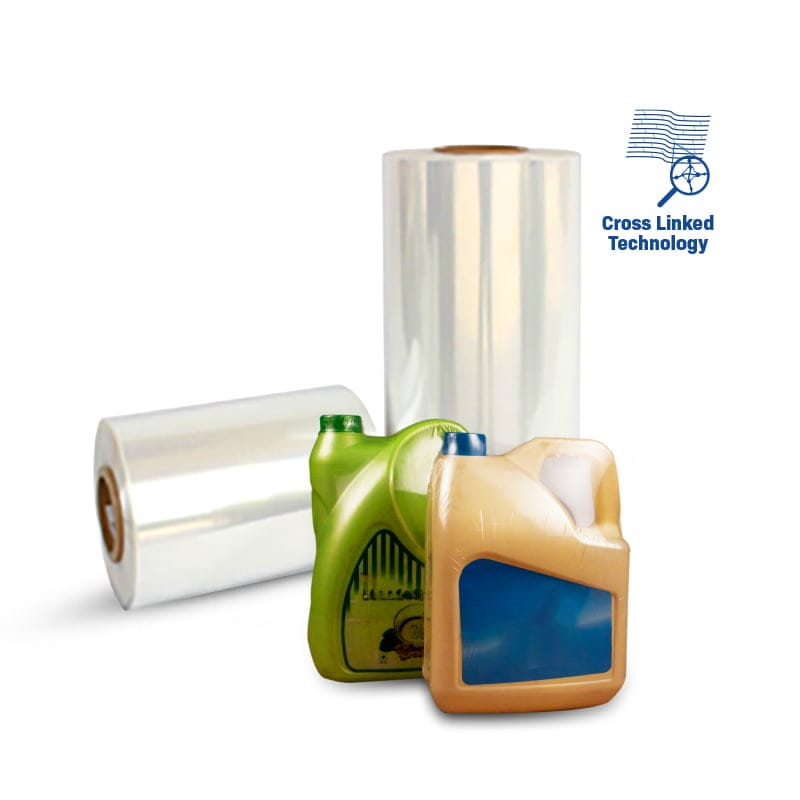
- Cross-Linked Shrink Films: Cross-Linked Shrink Films are manufactured by using cutting-edge radiation or chemical cross-linking technology. These films are designed for high-speed, heavy-duty, and high-performance packaging lines.
- Sustainable POF Shrink Films: Sustainable POF Shrink Films are made from 30% Post-Consumer Recycled and 30% Post-Industrial Recycled content, which reduces waste and initiates recycling. These biodegradable films break naturally without harming the environment.
These films are manufactured using advanced multi-layer co-extrusion technology for enhanced performance.
What Is Cross-Linked POF Film?
Cross-Linked POF Film is a special type of Polymer Film that is crosslinked and then subjected to electron beam irradiation, thereby enhancing tear and puncture resistance. It is the preferred choice for heavy-duty food packaging where durability is crucial.
What Is Non-cross-linked POF film?
Non-Cross-Linked POF Shrink Film is a multilayer film that offers a perfect balance of cost-efficiency, clarity, and ease of use.
Applications of POF Shrink Film
POF Shrink Film is widely used across industries for packaging applications such as:
1. Food & Beverage Packaging
- Bakery items
- Confectionery products
- Bottles and multipacks
2. Retail & Consumer Goods
- Cosmetics and personal care products
- Toys and stationery
- Household items
3. Printed & Promotional Packaging
- Books, magazines, and gift packs
- Promotional bundles
4. Industrial & General Packaging
- Small equipment
- Hardware items
- Multi-product bundling
These applications highlight its versatility and adaptability in modern packaging systems.
Advantages Of POF Shrink Film
- Enhanced Product Presentation: High clarity and gloss improve product visibility and branding appeal
- Strong & Reliable Packaging: Protects against dust, scratches, and minor damage
- Cost-Effective Solution: Lightweight and efficient material reduces packaging costs
- Compatible with Automation: Works seamlessly with both manual and high-speed packaging machines
Safe & Clean Packaging: Non-toxic and suitable for general packaging applications
How Is POF Different From PVC Shrink Film?
Let’s understand the difference between POF and PVC Shrink Film:
| Features | POF | PVC |
| Food Safe | Yes (FDA Approved) | No (Not safe for direct contact) |
| Flexibility | Soft & flexible | Rigid & brittle |
| Sealing Strength | Strong, Tear-Resistant | Prone to splitting |
| Environmental Safety | Low emissions, recyclable | Releases toxins when heated |
| Appearance | Glossy, high-clarity finish | Clear but tends to yellow over time |
What Are The Types Of Shrink Films Used In Food Packaging?
The following are the types of Shrink Films used in food packaging:
- Polyolefin (POF) Shrink Film: It is a highly durable shrink film that is FDA-approved for direct food contact. Known for its high clarity and excellent tensile strength, it is widely used across multiple industries for packaging a variety of products, offering both strong protection and enhanced visual appeal.
- Polyvinyl Chloride (PVC) Shrink Film: It is cost-effective and should not be used for food packaging. It releases harmful fumes when heated. It is not FDA-compliant, so it is not a good option for food packaging directly.
- Polyethylene (PE) Shrink Film: Thick and tough, mainly used for bundling and secondary packaging like water bottles and cans.
What Food Products Are Commonly Packaged With POF Shrink Film?
These are the food products commonly packaged with POF Shrink Film:
- Baked goods (bread, cookies, muffins).
- Fresh produce (fruits, vegetables).
- Frozen foods (pizza, ready meals).
- Confectionery (chocolates, candies).
- Meat and cheese (secondary packaging).
- Snack foods (granola bars, popcorn).
Best Practices for Food Packaging with POF
When using Polyolefin (POF) shrink films for food packaging, following the right practices ensures product safety, freshness, and presentation:
- Choose food-grade, FDA-approved Film: Always use certified POF films suitable for direct food contact.
- Maintain proper sealing temperature: Avoid overheating or underheating to ensure strong, clean seals without damaging the film.
- Ensure hygiene standards: Keep packaging areas clean to prevent contamination, especially for edible products.
- Use appropriate film thickness: Select the right gauge based on product weight and handling requirements.
- Optimize shrink settings: Proper heat and airflow settings help achieve a tight, wrinkle-free finish.
- Store films correctly: Keep POF rolls in a cool, dry place to maintain performance and shelf life.
Conclusion
Polyolefin (POF) Shrink Film is a versatile, food-safe, and recyclable packaging solution. It is widely adopted in the food industry. It stands out for its clarity, strength, and adaptability to various product types and packaging systems. By following best practices and proper storage methods, businesses can maximize shelf life and presentation quality using POF Shrink Wrap.
FAQs
Can POF Shrink Wrap Be Used For Frozen Foods?
No, POF shrink wrap is not ideal for frozen foods, as it is not designed for long-term exposure to deep-freeze conditions. For better protection against moisture loss and freezer burn, thermoforming films are a more suitable choice, offering stronger sealing and enhanced durability for frozen packaging applications.
Does It Protect Food From Moisture And Oxygen?
No, POF shrink film does not provide effective protection against moisture and oxygen. It is not a barrier film and is mainly used for outer packaging, offering clarity and basic protection.
How Should POF Film Be Stored?
Store in a cool (15–30°C), dry place away from direct sunlight and humidity. Avoid high heat, which can affect shrink properties.