If the packaging is the first thing that your customer sees, why not make it perfect by understanding the types of packaging films?
It is necessary because of the ever-evolving world of packaging; the choice of packaging film significantly impacts the product. By using this, you can simply enhance the product’s shelf life, visual appearance, protection, and overall cost-effectiveness. Whether you are a distributor helping clients or a manufacturer packaging your products, you must choose the right packaging solution.
Understand the types of packaging films to make your decision more effective. This blog explores the major categories, applications, properties, and industry insights related to various packaging films.
What Are Packaging Films?
Packaging films are thin plastic or polymer sheets used to wrap or contain products for protection, preservation, display, or distribution. They serve as a barrier to lock in moisture, oxygen, dust, and other environmental factors while also enabling branding and labeling.
List Of Top 8 Types Of Packaging Films
Different industries use different types of packaging films depending on their packaging requirements. Here are the top 8 types of packaging films commonly used across industries:
1. Polyethylene (PE) Films
Polyethylene is the most extensively utilized polymer in the packaging sector for many justifiable reasons. The material is flexible, resistant to moisture, light in weight, and economical in nature, making it the base for regular packaging products. There are three main types of PE films, which are as follows:
- LDPE or Low-density Polyethylene: LDPE films are highly flexible and transparent in nature. They are mainly used in making grocery bags, packaging films, agricultural sheets, and shrink films. They are FDA-approved for direct food contact.
- HDPE or High-density Polyethylene: HDPE films are rigid compared to LDPE. They find applications in making heavy industrial packaging, milk bottles, and lining materials that require tensile strength.
- LLDPE or Linear Low-density Polyethylene: LLDPE films combine the properties of LDPE and HDPE and thus find applications in stretch films and grocery bags.
Application: Food packaging, grocery bags, industrial wrapping films, agriculture films, and stretch films.
2. Polypropylene (PP) Films
Polypropylene Films are popular for their superior clarity, high-gloss finish, and high resistance to moisture, grease, and chemicals. They are the go-to films when a package needs to look good in the store. Two common variations of polypropylene films are:
- BOPP (Biaxially Oriented Polypropylene): Made through orienting the polymer in both longitudinal and transverse axes, BOPP films provide very high tensile strength, clarity, and printability. They are often used in bags for snacks, labels, wraps for biscuits, confectionery packaging, and adhesives. BOPP films are also one of the best materials for printing on.
- CPP (Cast Polypropylene): Primarily used as a sealant layer in multilayer laminations, CPP films offer great heat sealability and tear strength. Common uses include food pouches and medical packaging.
Good for: Snacks, baked goods, candies, labels, wraps, ready-to-eat meals.
3. Polyester (PET) Films
Polyester or PET (Polyethylene Terephthalate) Films: High-performance polymers providing outstanding tensile strength, heat resistance, and barrier to oxygen, water vapor, and other gases. When high clarity and toughness are needed, look no further than PET.
- BOPET (Biaxially Oriented PET Film): Featuring high tensile strength, good dimensional stability, and excellent barrier properties, BOPET film is a versatile material used for food packaging, electronics applications, and medical devices.
- APET (Amorphous PET Film): Offering high clarity and impact resistance, APET film is often selected for use in food trays and packaging, and cosmetics packaging.
Also finding increasing use in sustainable packaging applications: recycled PET (rPET) film derived from post-consumer bottles.
Recommended for: Snack foods, frozen foods, beverages, premium packaging, electronics.
4. Thermoforming Films
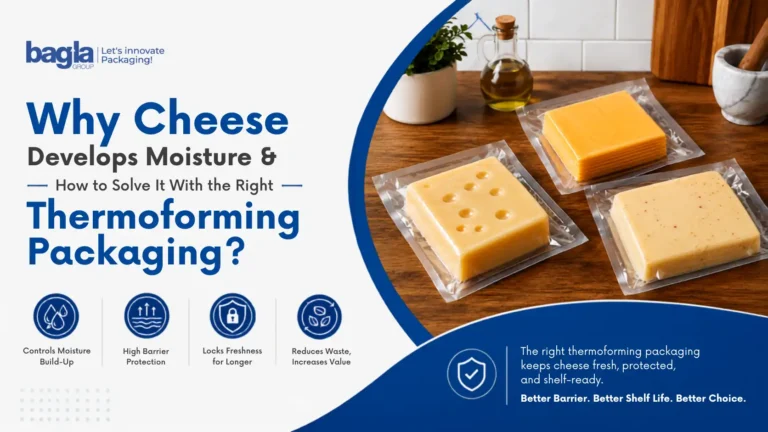
Thermoforming Films are special packaging films that are heated up and then thermoformed on a mold to produce rigid or semi-rigid containers such as trays, blisters, and clamshells. These films represent an important innovation in the fresh meat, dairy, and cheese packaging industry. There are basically two types, depending on their barrier:
- High-Barrier Thermoforming Films: Utilize special polymers such as EVOH (Ethylene Vinyl Alcohol) or PA (Nylon), offering superior oxygen barrier characteristics resulting in a long shelf-life of packed products. Perfect choice for vacuum-packed meats, fish, and processed foods.
- Medium-Barrier Thermoforming Films: Combining protection with affordability, medium-barrier films are best suited for those products that have moderate shelf-life expectations, such as cheese, deli meats, and ready-to-eat meals.
QuenchTek Thermoforming Films, manufactured by Bagla Group, is specifically engineered for high-speed thermoforming operations and provides reliable results for various food packaging applications.
Best for: Meats, poultry, seafood, cheese, processed foods.
5. POF (Polyolefin) Shrink Films
POF Shrink Films are Co-Extruded Multi-Layer Films using polyolefin resins (polyethylene and polypropylene). On application of heat, the film wraps the product, giving an aesthetically pleasing, tamper-evident, clear wrap.
POF Shrink Films have mostly superseded PVC Shrink Films owing to their superior clarity, food safety compliance, and environmentally friendly properties. There are two main categories of POF shrink films:
- Cross-Linked POF Shrink Films: Superior strength, great hot slip performance, and suitability for high-line-speed applications.
- Non-cross-linked POF Shrink Films: Cheaper option, best for routine applications that do not require ultra-high line speed.
WrapTek series of POF Shrink Films by Bagla Group (includes WrapTek Fresh – Anti-Fog Shrink Film for fresh fruits and WrapTek Earth, Recycle-Based POF Shrink Film with 60% recycle content) offers more than 30 years of manufacturing experience, catering to 50 different countries.
Best For: Retail item bundling, food products packaging, cosmetics packaging, stationery products packaging, DVD packaging, gift packing, and FMCG overwrap.
6. Nylon (PA) Films
Nylon / Polyamide (PA) Films are renowned for having excellent puncture resistance, exceptional oxygen barrier, and flexibility down to low temperatures. They form the preferred film choice when it comes to vacuum packaging.
Multilayered nylon films (such as Nylon/PE or Nylon/EVOH/PE) are generally applied to leverage the benefits of both sealability and barriers in food processing. Due to their excellent heat resistance, nylon films can be processed through boiling and retort processes.
Ideal for: Vacuum packaging, boil-in-bag products, meat products, cheese, and frozen foods.
7. Barrier and Laminated Films
In cases where a single polymer cannot fulfill all packaging demands, there are the multilayer films of coextruded or laminated type available that combine several layers of materials to attain particular characteristics, such as using BOPP as an exterior film for printing purposes, middle EVOH for barrier against oxygen, and internal PE for heat sealing. Types of laminates can be as follows:
- BOPP/BOPP: for ordinary food packaging
- PET/PE: for pouches and retort packs of foods
- PET/Foil/PE: for super high barrier use
- Nylon/EVOH/PE: for meat vacuum-packed packaging
Multilayer laminates form the base of flexible packaging, used in all places where one-layered film cannot fulfill demands due to lack of required protection, seal quality, or appearance.
Recommended for: Pouches, stand up pouches, retort packs, snacks, coffee, and pet food.
8. Sustainable and Biodegradable Films
As sustainability moves to the top of the global packaging agenda, bio-based and recyclable films are gaining significant traction:
- PLA (Polylactic Acid) Films: Made from renewable corn starch or sugarcane, PLA films are compostable under industrial conditions and are increasingly used for fresh produce, bakery, and foodservice packaging.
- Cellulose-Based Films: Natural, compostable, and derived from wood pulp, these films offer excellent twist-wrap properties for confectionery.
- Mono-Material PE/PP Films: Designed for recyclability in existing plastic recycling streams, these films replace complex multi-material laminates with structures made from a single polymer family.
- PCR (Post-Consumer Recycled) Films: Incorporate recycled plastic content, reducing virgin plastic usage and carbon footprint.
Bagla Group is at the forefront of this shift with its sustainable product lines, including the WrapTek Earth recycled POF shrink film and EkoRip paper-based recyclable carton tear tape, helping brands meet their packaging sustainability commitments.
Best for: Fresh produce, bakery, compostable packaging, eco-conscious brands, and regulatory compliance.
How To Choose The Right Packaging Film?
When you are searching for the right packaging films, you have two options: you can simply check the features mentioned below.
- Product Type – Check the type of the product first because for different items, different films are required, such as:
- Perishable? – EVOH or Nylon
- Heavy or sharp-edged? – Nylon or multilayer
- Fragile or lightweight? – LDPE or BOPP
- Environmental Conditions – You must check which film is best as per the environmental conditions.
- Freezer storage? – Nylon
- Heat-sealing? – CPP or PET
- High humidity? – Avoid moisture-sensitive films like EVOH unless layered
- Visual Appeal – If you are looking for films that look glossy and transparent, then you must opt for the following:
- Need transparency in food packaging? – BOPP or PET
- Glossy finish? – BOPP
- Matte texture? – Specialty PE or laminates
- Sustainability Requirements – For those who are looking for a sustainable option, they must choose:
- Looking to reduce plastic waste? → PLA or cellulose-based films
- Recyclability needed? → Mono-material PE or PP films
Note: You can connect with the expert team of Bagla Group, a packaging solution provider, who will provide you with proper guidance to choose the right packaging for your products.
Packaging Films by Application Category
| Application | Best Film Options |
| Snacks | BOPP/CPP, PET/PE Laminates |
| Frozen Foods | Nylon/PE, PET/EVOH/PE |
| Ready-to-eat Meals | Retort Laminates (PET/Alu/CPP) |
| Bakery & Confectionery | BOPP, PE, Compostable PLA |
| Industrial Packaging | HDPE, Shrink LDPE, BOPP Tapes |
Conclusions
Choosing the right types of packaging films is more than a technical decision. It is a strategic decision that affects your product’s safety, branding, sustainability, and consumer appeal.
If you’re a packaging distributor, being knowledgeable about these film types can help you guide your clients better. If you’re a product manufacturer or user, this guide helps you make informed choices that align with your goals.
As the demand for efficiency, safety, and eco-friendliness grows, so does the importance of staying updated with the latest in packaging film technology.