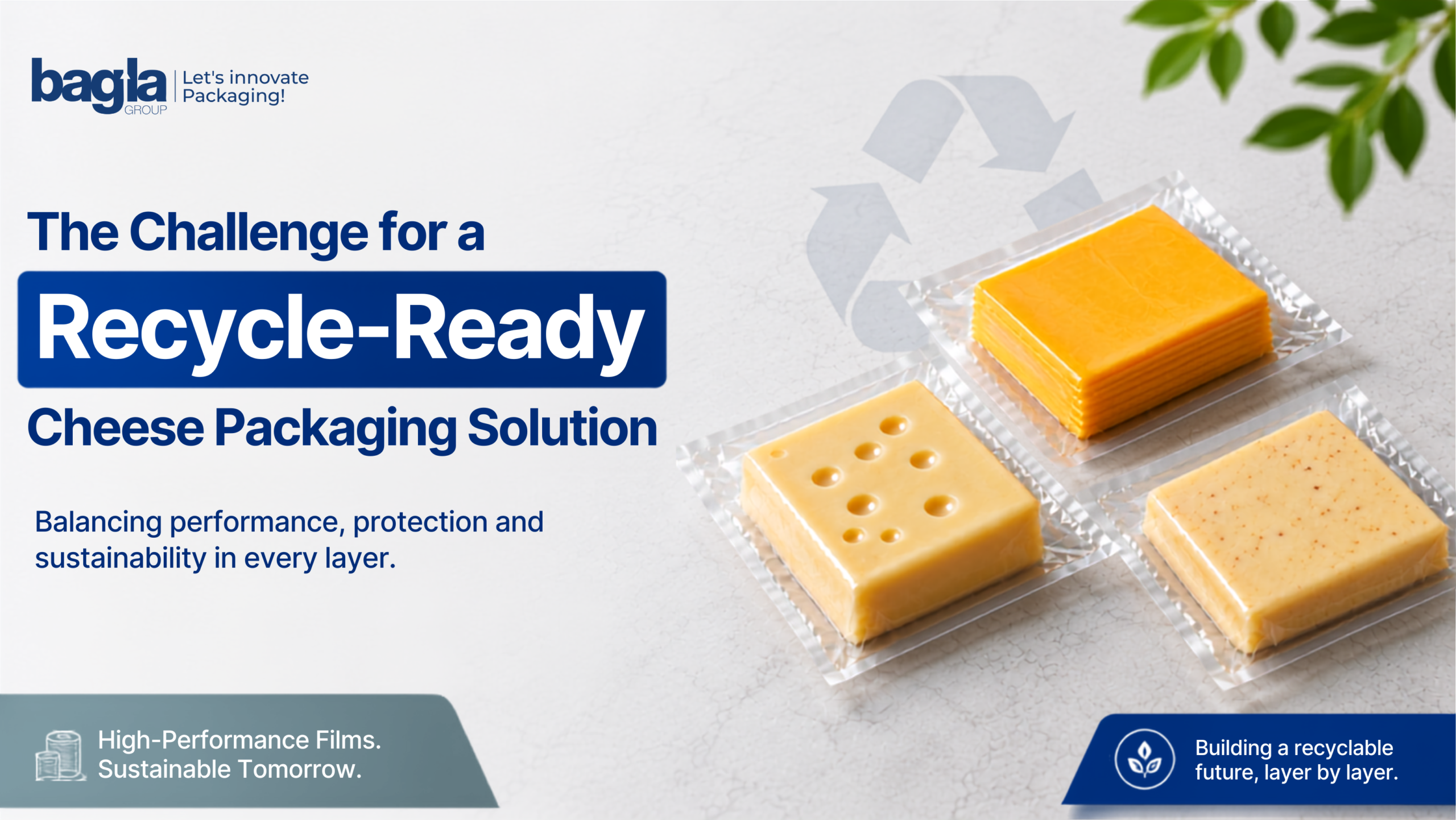
Cheese packaging has quietly become one of the toughest problems in flexible packaging. It needs to block oxygen and moisture, survive cold-chain handling, run cleanly on high-speed lines, and now, increasingly, it has to be recyclable too. That last requirement is where things get complicated, and it’s exactly why the conversation around a Recycle-Ready Cheese Packaging Solution has moved from “nice to have” to “board-level priority” for cheese brands across North American and European Markets.
If you’re a packaging distributor fielding calls from cheese processors right now, you already know the tension. Buyers want sustainability claims they can put on-pack. Their compliance teams want documentation that holds up under EPR audits. And their production teams still need films that don’t fail on the line at week three. Finding a Recycle-Ready Cheese Packaging Solution that checks all three boxes at once is the real challenge — and it’s the one we’re going to unpack in this article.
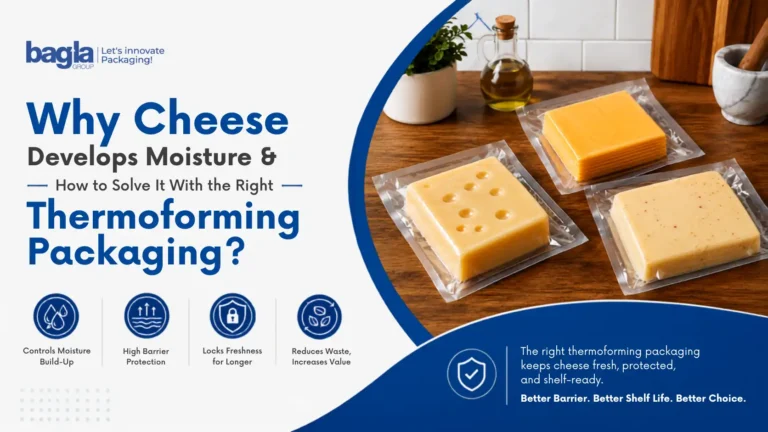
Why Cheese Packaging Is Uniquely Hard to Make Recyclable?
Most flexible packaging conversations about recyclability start with snack bags or produce pouches. Cheese is a different animal entirely, and understanding why helps explain why a genuinely recycle-ready cheese packaging solution has taken this long to mature.
- Oxygen and moisture barrier requirements are unusually high: Cheese is a living product — it continues to age, release moisture, and interact with its environment after packaging. A film with weak barrier performance leads to mold, rind defects, moisture loss, and shortened shelf life. Historically, the easiest way to hit these barrier targets was to laminate multiple different polymer layers together, often including EVOH or metallized layers, sometimes paired with PET or nylon. That construction works beautifully for shelf life. It’s also almost impossible to recycle through standard polyethylene (PE) film recycling streams because the material families don’t separate cleanly.
- Seal integrity has to survive real-world abuse: Cheese packaging gets vacuum-sealed, shrink-wrapped, gas-flushed (MAP), sliced, resealed, and shipped through variable cold-chain temperatures. Any recyclable alternative has to match — not approximate — the seal strength and puncture resistance of legacy multi-material laminates, or processors simply won’t switch.
- Grease and fat resistance adds another layer of complexity: Cheese fats can degrade certain sustainable substrates over time, which is one of the underrated reasons early mono-material trials in the category stalled.
- Format diversity multiplies the engineering problem: A recyclable dairy film designed for block cheese won’t necessarily work for shredded, sliced, or string cheese formats — each has different barrier, clarity, and machinability needs, and each runs on different equipment.
Put simply: cheese packaging sits at the intersection of high barrier demand and high recyclability pressure, which is precisely the combination that’s hardest to solve.
The Regulatory and Retail Pressure Driving Demand
The push toward compliant, mono-material dairy packaging isn’t coming from one direction — it’s converging from several at once, and distributors are feeling it from every customer segment.
- Extended Producer Responsibility (EPR) laws are now active or advancing in California, Colorado, Oregon, Maine, and Minnesota, with more states drafting similar legislation. These laws financially penalize brand owners for packaging that can’t be recycled, shifting cost pressure directly onto the packaging decisions distributors help make.
- How2Recycle labeling standards have tightened, meaning multi-material laminates that used to qualify for a “check locally” label increasingly can’t claim recyclability at all.
- Retailer scorecards, particularly from major grocery chains, now score suppliers on packaging recyclability as part of vendor evaluations — turning sustainable packaging from a marketing nice-to-have into a shelf-space qualifier.
- Corporate sustainability commitments from national and regional cheese brands are creating internal deadlines that filter straight down to procurement and, from there, to distributors.
For distributors, this means customers aren’t asking “do you have anything more sustainable?” anymore. They’re asking, “Can this specific film pass our recyclability audit while keeping our current shelf life?” That’s a much harder — and much more commercially urgent — question.
What Makes a Cheese Film Genuinely “Recycle-Ready”?
There’s a lot of loose language in the market right now, so it’s worth being precise. A genuinely recyclable cheese packaging structure generally needs to meet these criteria:
- Mono-material construction, predominantly polyethylene (PE) or polypropylene (PP) based, rather than mixed-polymer laminates that confuse sorting systems at material recovery facilities (MRFs).
- Compatibility with existing PE film recycling streams, including drop-off collection programs like How2Recycle’s Store Drop-Off network.
- Barrier performance equivalent to legacy structures, achieved through advanced coatings or specialty PE formulations rather than through adding incompatible barrier layers.
- Machinability on existing equipment – form-fill-seal, flow-wrap, and vacuum-pack lines shouldn’t need a capital overhaul to run the new film.
- Third-party recyclability certification or documentation that brand owners can cite in EPR reporting and on-pack claims.
This is the bar that separates a genuinely recyclable dairy film from a film that’s simply been rebranded as “eco-friendly” without the underlying material science to back it up.
Introducing QuenchTek Mono: Bagla Group’s Answer to the Cheese Packaging Dilemma
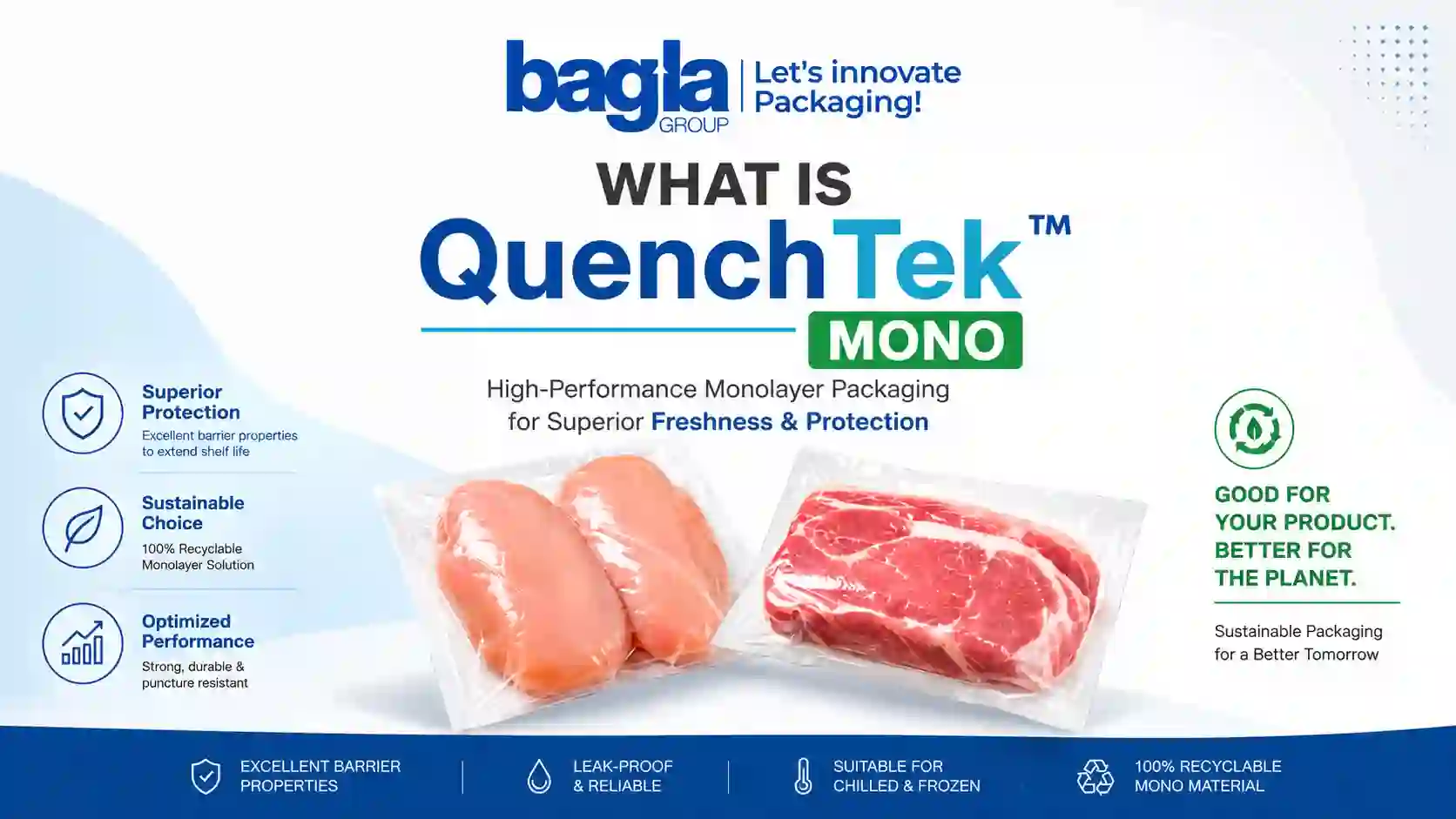
This is exactly the gap Bagla Group built QuenchTek Mono to close. Rather than starting from a legacy multi-material laminate and trying to strip layers out, QuenchTek Mono is engineered from the ground up as a mono-material PE structure specifically calibrated for high-moisture, high-fat dairy applications like cheese.
For distributors, the value proposition is straightforward: you get a mono-material dairy packaging film that doesn’t ask your cheese-processor customers to compromise on shelf life, seal performance, or line speed in exchange for a sustainability claim.
QuenchTek Mono Product Specifications:
Note: the figures below are provided as a general reference outline based on the product category. Please cross-check and confirm exact values with the live QuenchTek Mono specification sheet on bagla-group.com before quoting or distributing to customers.
| Specification | Detail |
| Material construction | Mono-Material Polyethylene (PE) Film. |
| Recyclability | Store Drop-Off / PE film recycling stream compatible. |
| Barrier performance | High oxygen (OTR) and moisture (WVTR) barrier via advanced PE coating technology. |
| Seal type | Heat-sealable, engineered for consistent hermetic seals. |
| Grease/fat resistance | Formulated for high-fat dairy contact. |
| Compatible formats | Block, shredded, sliced, and portion-cut cheese packaging. |
| Machine compatibility | Runs on standard flow-wrap, form-fill-seal, and vacuum-pack equipment. |
| Clarity/print surface | High-clarity substrate suitable for high-definition flexographic and gravure printing. |
| Certification | Supports third-party recyclability documentation for EPR and How2Recycle compliance. |
The logic behind QuenchTek Mono is what makes it worth stocking: instead of treating barrier and recyclability as opposing goals, Bagla Group’s formulation approach builds the barrier into the PE matrix itself, so you’re not sacrificing shelf life to hit a sustainability target — and you’re not sacrificing recyclability to hit a barrier target.
Why This Matters for Packaging Distributors Specifically?
You’re the layer between material science and commercial reality, which puts you in a uniquely valuable and uniquely exposed position on this issue.
- Your customers are asking you to de-risk their transition: Most mid-size and regional cheese processors don’t have in-house packaging R&D teams. They rely on distributors to vet materials, validate line compatibility, and stand behind performance claims. Carrying a proven recyclable cheese film like QuenchTek Mono lets you answer the sustainability question with confidence instead of a vague “we’re looking into options.”
- Compliance deadlines create urgency, and urgency creates opportunity: As EPR reporting requirements phase in across more states through 2026 and beyond, cheese brands will need to lock in compliant packaging well ahead of enforcement dates. Distributors who can offer a validated, documented, mono-material solution now — rather than scrambling later — capture that switching decision.
- Margin protection matters as much as sustainability: A mono-material PE film built on standard inputs and compatible with existing converting and packing equipment avoids the cost spikes that come with exotic substrates or capital-intensive line retrofits. That’s a conversation your customers’ procurement teams care about just as much as their sustainability teams do.
- Differentiation in a commoditized category: Flexible packaging distribution is competitive on price by default. Being the distributor who can speak fluently about mono-material recyclability, EPR compliance, and barrier engineering — backed by an actual product like QuenchTek Mono — sets you apart from competitors still selling legacy laminates as “the industry standard”.
Making the Switch: What to Expect
Transitioning a cheese processor from a legacy multi-material laminate to a Mono-Material Recyclable Film isn’t usually a same-week swap, and it’s worth setting that expectation with customers upfront. Typical steps include:
- Format and barrier assessment: Confirming shelf-life requirements for the specific cheese format (e.g., block, shredded, sliced).
- Line trial: Running QuenchTek Mono on existing form-fill-seal or flow-wrap equipment to confirm seal integrity and speed compatibility.
- Shelf-life validation: Side-by-side testing against the current structure over the product’s full shelf-life window.
- Documentation handoff: Providing recyclability certification and compliance documentation for the customer to use in EPR reporting and on-pack labeling.
- Rollout: Scaling from pilot SKUs to full production volume.
Distributors who walk customers through this process methodically, rather than just dropping off a spec sheet, tend to see much higher conversion from trial to full adoption.
Conclusion
The demand for a workable, recycle-ready cheese packaging solution isn’t a passing sustainability trend; it’s being locked in by state EPR law, retailer scorecards, and shifting consumer expectations, all landing on cheese processors’ desks at the same time. The processors who solve it early gain compliance headroom and marketing advantage. The ones who wait will be solving it under deadline pressure, with far less room to negotiate on cost or performance.
For distributors, that’s the opening. QuenchTek Mono from Bagla Group gives you a PA-free Thermoforming Film made with mono-material, barrier-engineered, machine-compatible answer you can bring to cheese processors today — not a promise of something coming down the line. If recyclable dairy packaging is a conversation your customers are already starting, it’s worth having the right recycle-ready cheese packaging solution in your line card before a competitor does.