With the fast revolution in the packaging industries, efficiency, appearance, and durability matter. The only material that has gained worldwide popularity in the United States packaging industry is shrink film. But the common question that arises in the mind is how shrink film works.
Bagla Group is a global leader that provides world-class packaging solutions, including polyolefin shrink films, serving industries such as food and beverages. This article will break down how shrink films work, why they are vital for packaging, and how businesses can benefit from choosing Bagla Group as their trusted partner.
What Is Shrink Film?
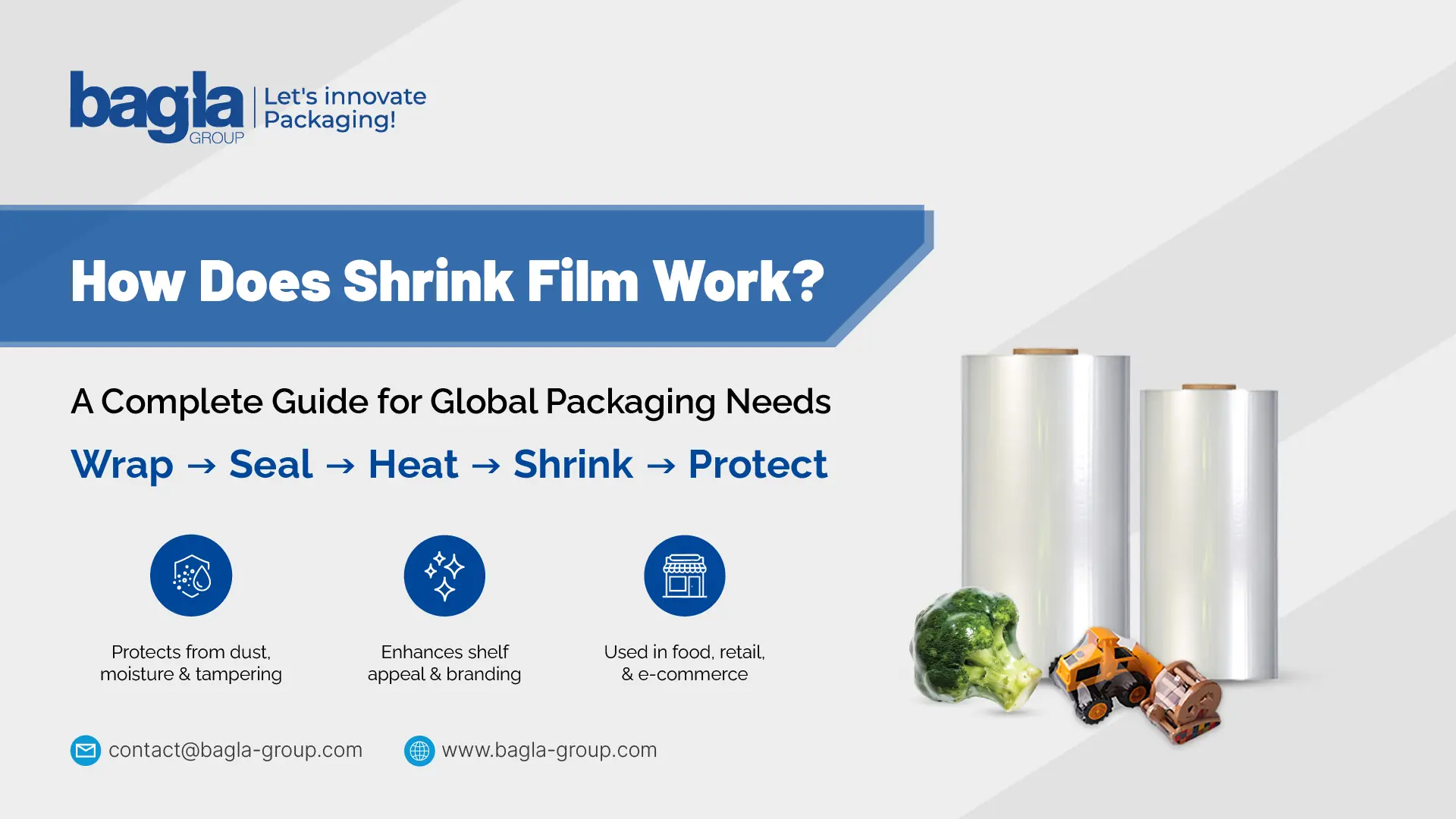
Shrink film is a kind of packaging, often referred to as shrink wrap. It is a thin-medium polymer-based packaging that shrinks tightly around products with heat application. Shrink film protects items from dust, moisture, and tampering. Shrink film is also good for product visibility and has a professional gloss finish. The common types of shrink film found on the market are:
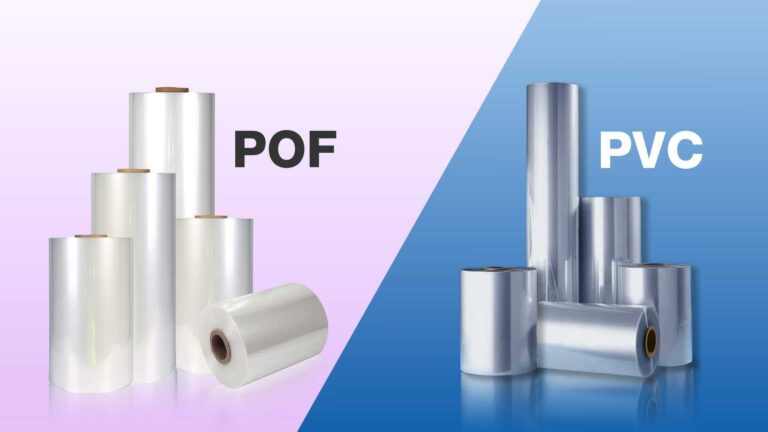
- Polyolefin (POF) Shrink Film
- Polyvinyl Chloride (PVC) Shrink Film
- Polyethylene (PE) Shrink Film
How Does Shrink Film Work? Step-by-Step
Shrink film operates by wrapping a product with a polymer film and applying heat to allow the film to shrink over the item. This protects the item, improves visibility, and provides tamper evidence. Here is the step-by-step process of shrinking film:
Step 1: Film and Product Preparation
The process begins with selecting a suitable shrink film, usually POF, PE, or PVC shrink film, which will depend on the product type, weight, and packaging requirements. It is essential that shrink films are stored properly and allowed to acclimate to prevent static or sticking. The product must be clean, dry, and free of dust and sharp edges so that it does not puncture the shrink film.
Step 2: Creating the Film Bag
The product is placed in the shrink film, which could either be as a folded layer (centerfold film) or a sleeve made by the machine. There should be a sufficient margin around the product for it to shrink tightly. Micro-perforations are made in the film in order to let the trapped air out to give the desired shrinkage to the film.
Step 3: Sealing the Film
Once the product is in the film, the packaging machine creates a seal with heat and pressure, typically an L-seal, side-seal, or cross-seal, depending on the equipment. The seal closes the product inside what is essentially a closed “bag” of plastic material. Sealing of the bag must occur without gaps or weak spots. A strong, shiny seal is a good indicator that the bags will be strong and will not tear.
Step 4: Removing Excess Air
Before the shrink process, excess air from inside the package must be expelled from the package. The air can be expelled via the perforations in the film or by simply pressing the package, gently, before sealing. Not expelling the air will prevent the package from inflating like a balloon and ensure that the film is a tight and smooth wrap.
Step 5: Applying Heat to Shrink the Film
The sealed package is then subjected to a shrink tunnel or a heat gun, which activates the memory of the stretched polymers in the film and shrinks the film back to its unstretched size. Well, as the film shrinks, it will wrap snugly around the product and take its shape.
Step 6: Shaping and Finishing in the Tunnel
Inside the heat tunnel, hot air flows evenly across the package, helping the film shrink smoothly around corners and contours. Airflow and temperature are carefully balanced to avoid wrinkles, burn marks, or loose areas. Perforations release any remaining air pockets during this stage.
Step 7: Cooling and Setting the Film
After the package emerges from the heat tunnel, the cooling fans or the ambient air facilitate the film set. The cooling process, in conjunction with the tightness of the film sets, provides clarity and seals strength, and allows for a secure, professional-looking package.
Step 8: Quality Check of the Finished Pack
Each package undergoes seal integrity, appearance, and fit verification. Film must be tight and smooth, with no wrinkles, nothing blistered, and no dog-ear or unmelted film at the corners. The barcode, branding, or label must be visible and scannable, and this is incredibly important because while the aesthetics are important, so too is function.
Step 9: Packing and Shipping
The finished wrapped product is collected, consolidated, packed in boxes and/or pallets, and shipped. Shrink film bundling is used if two or more pieces are bundled together, making it easier to control and transport. It is similar to the wrapped product so transferring bundles safely is a factor. Once the last step is done, the product is ready to be shipped.
Why Shrink Film Is Popular In Packaging?
Shrink films have widespread acceptance, primarily attributed to their flexibility and cost. Consider these factors as to why shrink film is a preferred packaging solution throughout the US as well as the world.
- Product Protection: Protects the product from moisture, dirt, and damage.
- Tamper Evidence: Provides safety and authenticity – especially important in food and pharmaceutical applications.
- Shelf Appeal: The clear film allows for brand promotion and product appearance.
- Affordable: These films are cheaper than other traditional packaging techniques.
- Space saving: Shrink wrap hugging the product reduces packaging.
- Sustainable options: POF films are recyclable and safer than PVC.
Applications Of Shrink Films In Different Industries
Shrink films are not limited to one industry. From food and beverage to retail and consumer goods to pharmaceuticals and e-commerce & logistics, the versatility of shrink films means they are found all over the world in many different industries:
- Food Production: Packaging baked goods, frozen food, pizza, and produce.
- Beverages: Deliumping bottled water, packs or cans of juice. and beverages.
- Retail & Consumer Goods: Protecting electronics, toys. books. and cosmetics.
- E-commerce & Logistics: Securing products for long-range shipping
- Industrial Products: Shrink wrapping hardware, tools, and automotive parts.
Benefits Of Choosing Polyolefin (POF) Shrink Films
While different shrink films exist, POF shrink films stand out for global businesses. Key benefits include:
- Superior clarity that enhances retail shelf appeal.
- High strength with tear resistance and durability.
- Eco-friendliness, as they are 100% recyclable.
- Food safety, being approved for direct contact with consumables.
- Versatility across high-speed machines and diverse product sizes.
Bagla Group is a leading manufacturer of POF shrink films, delivering premium quality solutions for industries worldwide. if you are facing any issues, then read our Common POF Shrink Film Wrapping Problems for a better understanding with solutions.
How Shrink Films Help Businesses In The United States
For companies in the U.S., shrink films play a vital role in supply chain efficiency and retail readiness:
- E-commerce packaging – Protects goods during cross-country shipping.
- Retail branding – Transparent films allow brands to showcase product quality.
- Regulatory compliance – Food-safe and eco-friendly materials meet U.S. standards.
- Cost reduction – Optimized packaging lowers storage and transport costs.
Why Choose Bagla Group For Shrink Films?
With decades of expertise, Bagla Group is among the world’s most trusted names in packaging innovation. Here’s why global businesses, especially in the United States, choose us:
- Global reach with exports to over 80 countries.
- State-of-the-art manufacturing facilities producing world-class POF shrink films.
- A focus on sustainability and eco-friendly solutions.
- Customer-centric approach with customized packaging support.
- International quality certifications ensuring safety and compliance.
Future Of Shrink Films In Packaging
With growing demand for sustainable packaging, shrink films are evolving:
- Biodegradable shrink films are emerging.
- Thinner yet stronger films are reducing material waste.
- Automated shrink wrapping is streamlining production.
Bagla Group is at the forefront of these innovations, ensuring businesses worldwide stay ahead.
What is Shrink Film Made From?
The materials shrink films made from are polyolefin (POF), polyethylene (PE), and polyvinyl chloride (PVC)
Is Shrink Film Safe for Food Packaging?
Yes, especially POF shrink films, which are FDA approved for food contact.
Do Shrink Films Work for Larger or Odd-Shaped Products?
Definitely, there is shrink film for almost any shape and size of products!