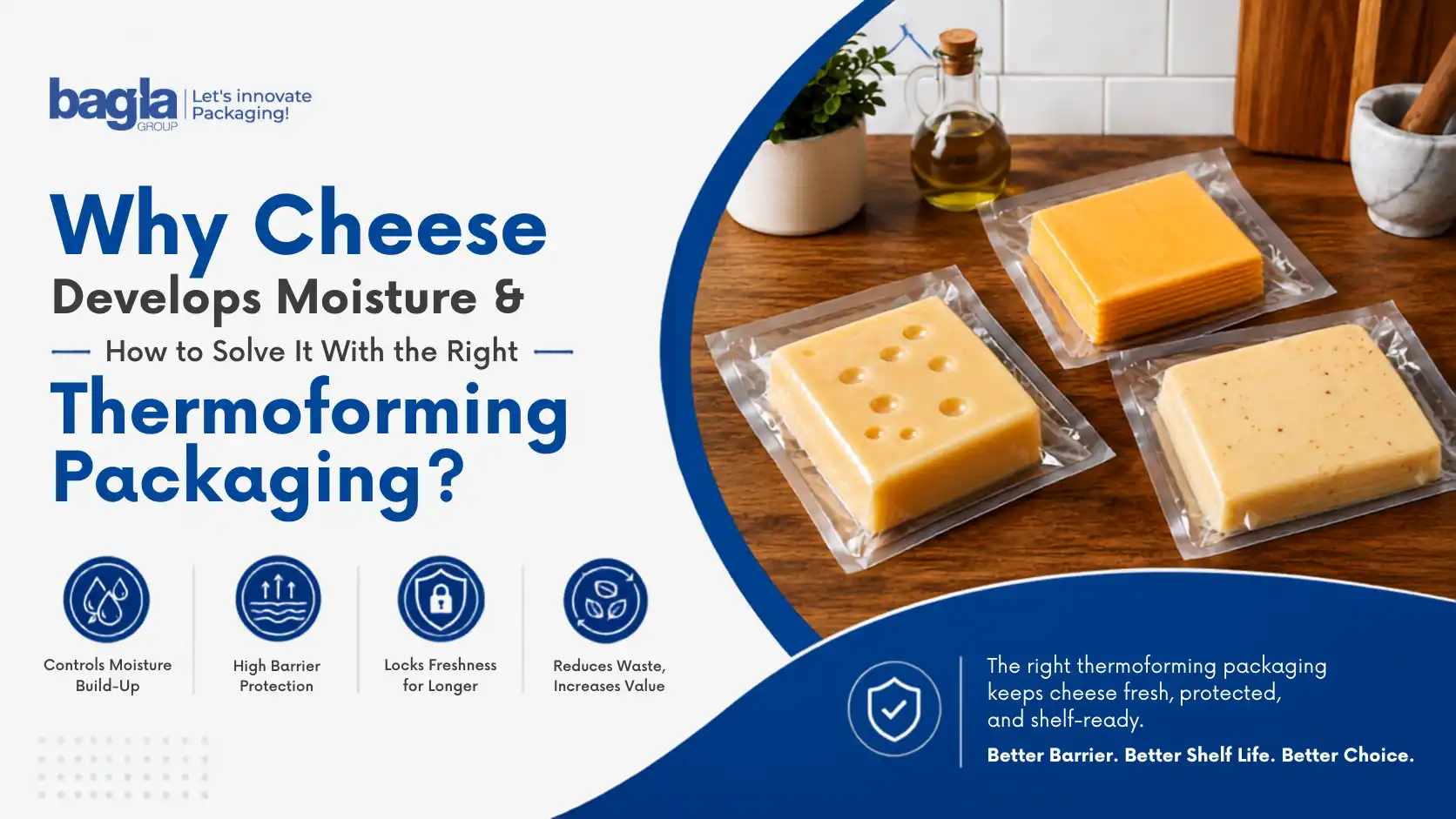
If you have ever opened a pack of cheese to find beads of water clinging to the surface, a slippery film coating the block, or an unpleasant sour smell that wasn’t there a few days ago, you have witnessed moisture migration in action. For cheese manufacturers, distributors, and retailers, this isn’t just a cosmetic issue — it is one of the leading causes of spoilage, shortened shelf life, and consumer complaints in the dairy category.
Understanding why cheese develops moisture is the first step toward preventing it. And as we will explore in this article, the solution isn’t limited to refrigeration or recipe adjustments — a large part of the answer lies in how the cheese is packaged and sealed, right down to the tear tape used to open the pack.
What Is Moisture Development in Cheese?
Cheese naturally contains moisture, and its composition continues to change throughout storage. Depending on the type of cheese, moisture can move within the product or interact with the surrounding atmosphere inside the package.
When this moisture is not adequately controlled, it can appear as condensation on the inside of the packaging film or as visible moisture on the cheese itself. In some cases, excessive moisture can contribute to undesirable texture changes and create conditions that accelerate quality deterioration. Moisture-related conditions in cheese packaging are commonly associated with:
- Moisture migration
- Condensation build-up
- Syneresis, particularly in softer cheeses
- Sweating, a common term for visible surface moisture
These conditions can have different causes, but they all highlight the importance of maintaining an appropriate balance between the cheese, its storage environment, and the packaging system.
The Core Reasons Cheese Develops Moisture
Here are several factors that can contribute to moisture buildup in cheese:
1. Temperature Fluctuations During Storage and Transport
Temperature changes are one of the major contributors to condensation in packaged cheese.
A cheese pack may move through several environments during its journey from production to consumption, including refrigerated storage, transportation, loading areas, distribution centers, and retail refrigeration.
When the temperature changes, the amount of moisture that air can hold also changes. Rapid cooling can cause moisture to condense on the coldest surface inside the package, which may be the packaging film or the cheese itself.
This makes consistent refrigeration important, but it also highlights why the packaging needs to maintain its protective properties throughout the distribution cycle.
2. Poor or Inconsistent Cold Chain Management
Maintaining the correct temperature from production through distribution is essential for cheese quality.
Repeated temperature fluctuations can increase the likelihood of condensation and other quality issues. Even a well-designed packaging system cannot compensate for consistently poor storage conditions.
For this reason, packaging selection and cold-chain management should be considered together when addressing moisture-related problems.
3. High Residual Moisture Content in the Cheese
Different cheese varieties naturally contain different levels of moisture.
Fresh and semi-soft cheeses such as mozzarella, paneer, and ricotta generally have higher moisture content than many aged or hard cheeses. This moisture can interact with the atmosphere inside the package throughout storage.
If the packaging system does not provide the appropriate level of moisture and gas control for the product, moisture may accumulate inside the pack or, conversely, the cheese may lose moisture and become dry.
The packaging film therefore needs to be selected according to the specific characteristics of the cheese rather than using a one-size-fits-all approach.
4. Inadequate Barrier Properties of the Packaging Film
This is where packaging selection becomes particularly important.
The film used for cheese packaging needs to provide an appropriate barrier against the movement of gases and moisture while maintaining the other properties required by the packaging process.
A film with insufficient barrier protection may allow excessive transmission of oxygen or moisture, potentially affecting product quality and shelf life.
5. Inconsistent Seal Integrity
Even a high-performance barrier film cannot deliver its intended protection if the package seal is compromised.
Weak or inconsistent seals can allow external air and moisture to enter the package and can affect the controlled atmosphere created during vacuum or modified atmosphere packaging.
Seal quality depends on several factors, including film compatibility, sealing temperature, pressure, dwell time, equipment settings, and the cleanliness of the sealing area.
This is why Thermoforming Film selection should always be considered alongside the actual packaging process.
How Thermoforming Packaging Helps Control Cheese Moisture?
When moisture-related problems persist, the packaging format itself deserves close attention.
Thermoforming packaging allows manufacturers to form the packaging film around the product before filling and sealing. When the appropriate film structure is selected, the resulting package can provide a controlled environment designed around the requirements of the cheese.
Thermoforming can support cheese packaging in several important areas:
- Barrier Protection: The right Thermoforming Film can provide the required barrier against oxygen and moisture transmission, helping protect the cheese throughout refrigerated storage and distribution. The appropriate barrier level depends on the cheese variety, moisture content, shelf-life target, storage conditions, and packaging atmosphere.
- Reliable Sealing: A consistent seal is essential for maintaining package integrity. Thermoforming Films designed for food packaging can be selected to work with the sealing process and equipment, helping manufacturers achieve consistent pack closure when the appropriate processing parameters are maintained.
- Vacuum and MAP Compatibility: Cheese packaging may use vacuum packaging or modified atmosphere packaging depending on the product and shelf-life requirements. Thermoforming systems can support these packaging formats by creating a close-fitting package around the product and maintaining the intended internal atmosphere after sealing.
- Product Protection: Thermoforming allows the packaging film to follow the shape of the product, creating a compact package that can provide protection during handling, transportation, and refrigerated storage. A close-fitting package can also help reduce unnecessary package volume while maintaining the required product protection.
- Consistent Packaging Performance: For high-volume cheese production, packaging consistency is critical. The film needs to perform consistently through forming, filling, sealing, handling, and distribution. Variations in forming behavior, sealing performance, or film properties can affect the final package and ultimately the product inside it. This makes Thermoforming Film selection an important part of the overall packaging specification.
Bagla Group Thermoforming Films for Cheese Packaging
For cheese manufacturers looking for high-performance food packaging solutions, Bagla Group’s Thermoforming Films offer different structures designed for demanding food packaging applications.
The QuenchTek range includes Thermoforming Film solutions that can be selected according to specific packaging requirements, including barrier performance, mechanical properties, forming requirements, and sealing needs.
QuenchTek HB
QuenchTek HB is a high-barrier Thermoforming Film solution for food packaging applications where strong barrier protection is an important part of the packaging specification.
For cheese applications where protection against external gases and moisture transmission is critical, a high-barrier structure can help create a more controlled packaging environment when matched correctly to the product and storage conditions.
QuenchTek MB
QuenchTek MB provides another Thermoforming Film option for food packaging applications requiring a balance of barrier performance and packaging functionality.
Its structure is based on PA and PE, providing the combination of properties required for demanding thermoforming applications.
QuenchTek MBPP
QuenchTek MBPP is another option within the QuenchTek range, using a PA- and PP-based structure specifically designed for high-temperature food packaging applications.
This solution can be considered where the packaging application requires the specific performance characteristics associated with this material combination.
QuenchTek Mono
As packaging sustainability requirements continue to evolve, material selection is becoming increasingly important.
QuenchTek Mono is a mono-material PE Thermoforming Film designed around a PE-based structure. It is PA-free and developed to support recyclability within existing PE recycling streams while maintaining the functional requirements of high-barrier food packaging. Its structure consists of: PE / PE / TIE / EVOH / TIE / PE / PE
QuenchTek Mono is particularly relevant for manufacturers looking to move toward mono-material packaging structures while continuing to require high-barrier performance from their thermoforming packaging.
Why the Right Thermoforming Film Matters for Cheese Moisture Control?
Choosing a Thermoforming Film should go beyond simply looking at thickness or barrier specifications. The packaging film needs to work as part of the complete packaging system. For cheese manufacturers, important considerations include:
- Moisture and Oxygen Barrier: The film should provide barrier properties appropriate for the cheese’s moisture profile, oxygen sensitivity, storage conditions, and intended shelf life.
- Forming Performance: The film needs to form appropriately around the product without compromising package quality during the thermoforming process.
- Sealing Performance: Consistent sealing is essential to maintain the package environment and prevent unwanted air or moisture exchange.
- Vacuum or MAP Requirements: If the product is packaged under vacuum or modified atmosphere, the film structure needs to be compatible with the selected packaging process.
- Mechanical Protection: The film should provide sufficient resistance to handling and transportation stresses while maintaining package integrity.
- Sustainability Requirements: For manufacturers working toward recyclable packaging structures, mono-material options such as QuenchTek Mono can provide an alternative approach to conventional multi-material packaging structures.
Practical Steps for Cheese Manufacturers to Reduce Moisture Issues
If moisture is appearing inside cheese packs, manufacturers should evaluate the entire packaging and distribution system rather than focusing on a single factor. Consider the following:
- Evaluate the cheese’s moisture profile and understand how it changes during storage.
- Review the film’s barrier properties, including its suitability for the product’s moisture and oxygen requirements.
- Audit the cold chain for temperature fluctuations between production, storage, transportation, and retail.
- Check thermoforming conditions to ensure the film is forming consistently around the product.
- Inspect seal consistency across the packaging line and verify that sealing temperature, pressure, and dwell time are appropriate.
- Review vacuum or MAP conditions if these packaging methods are being used.
- Test finished packs under realistic conditions, including refrigeration cycles, transportation simulation, and extended storage.
- Consider the complete film structure, rather than evaluating barrier performance in isolation.
A packaging trial under real-world conditions can help manufacturers determine whether the selected Thermoforming Film is delivering the required performance throughout the intended shelf life.
Conclusion
Cheese moisture is rarely caused by one factor alone. Temperature fluctuations, cold-chain performance, the cheese’s natural moisture content, barrier properties, and seal integrity can all influence what happens inside a package. That is why solving moisture-related packaging problems requires a complete packaging approach.
The right Thermoforming Film can play a central role by helping provide the appropriate barrier protection, forming performance, sealing characteristics, and compatibility with vacuum or MAP packaging. The film structure should always be selected according to the specific cheese, packaging process, storage conditions, and shelf-life requirements.
For cheese manufacturers evaluating their packaging systems, Bagla Group’s QuenchTek Thermoforming Films provide multiple options, including QuenchTek HB, QuenchTek MB, QuenchTek MBPP, and QuenchTek Mono, allowing packaging requirements to be addressed through different film structures.
FAQs
Moisture can develop because of temperature fluctuations, the natural moisture content of the cheese, condensation, cold-chain issues, or an unsuitable packaging barrier. The interaction between the cheese and the package environment determines how much moisture accumulates.
Yes. A Thermoforming Film with barrier properties appropriate for the specific cheese can help control moisture and gas transmission. However, film selection should be combined with proper sealing, storage, and packaging-process control.
Important factors include moisture and oxygen barrier requirements, cheese composition, forming performance, sealing characteristics, mechanical strength, vacuum or MAP compatibility, storage conditions, and shelf-life requirements.
The appropriate film depends on the cheese and packaging requirements. Bagla Group’s QuenchTek range includes QuenchTek HB, QuenchTek MB, QuenchTek MBPP, and QuenchTek Mono, providing different material structures and performance characteristics for food packaging applications.
QuenchTek Mono is a PA-free, mono-material PE Thermoforming Film with a PE-based structure incorporating an EVOH barrier layer. It is designed to support high-barrier food packaging requirements while being compatible with recycling within existing PE streams.
Thermoforming can be used with vacuum and modified atmosphere packaging, depending on the equipment, film structure, cheese type, and packaging specifications. The film and process should be validated for the intended application.