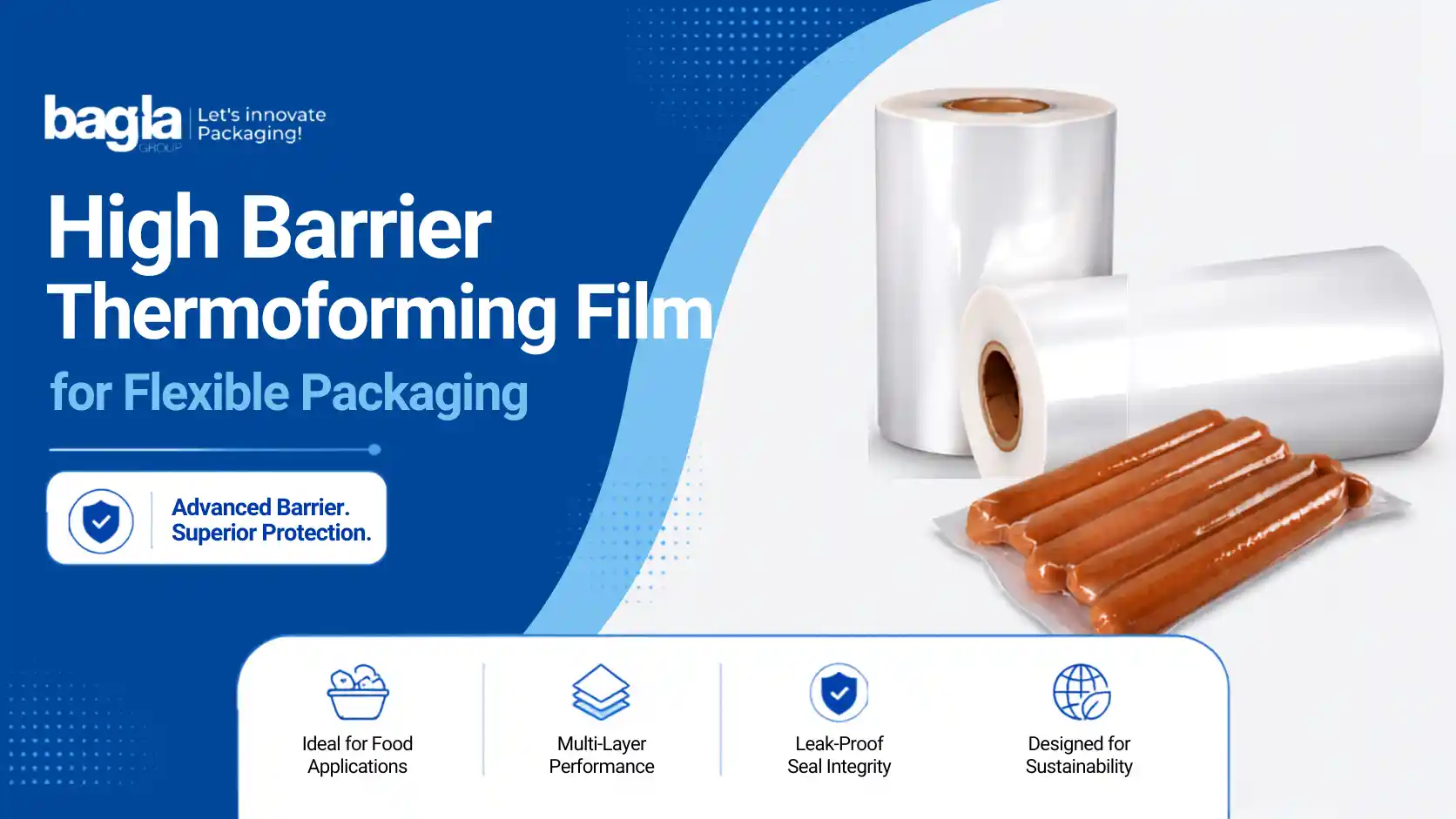
Flexible packaging has quietly become one of the most demanding corners of the packaging industry. Brands want longer shelf life, regulators want less plastic, and consumers want packs that still feel premium in hand. Sitting right in the middle of that tug-of-war is one unglamorous but critical component: high barrier Thermoforming Film for flexible packaging.
If you’ve ever wondered why some vacuum-packed cheese stays fresh for weeks while another turns cloudy and off-smelling in days, the answer usually comes down to the film. This guide breaks down what high barrier Thermoforming Film for flexible packaging actually is, why it matters, and how Bagla Group’s mono-material Thermoforming Film, QuenchTek HB, is helping brands get high performance without the recyclability headache.
What Is High Barrier Thermoforming Film?
Thermoforming Film is the base web that gets heated and vacuum- or pressure-formed into a cavity or tray shape on a thermoforming line — think of the bottom web in a form-fill-seal (FFS) machine that cradles cheese, meat, or ready meals before a top film seals over it. “High barrier” simply means the film has been engineered to slow down the movement of oxygen, moisture vapor, and aromas through its structure far more effectively than a standard film would.
In practical terms, a high barrier Thermoforming Film for flexible packaging needs to do three jobs at once:
- Block oxygen ingress: oxygen accelerates rancidity, discoloration, and microbial growth
- Control moisture transmission: keeps dry products crisp and moist products from drying out
- Preserve aroma and flavor: stops both flavor loss from the product and odor transfer from outside
Get any one of these wrong, and the shelf life claim on the pack becomes fiction.
Where This Film Is Used?
High barrier Thermoforming Films aren’t a niche product; they’re the backbone of several everyday categories:
- Processed and cured meats, poultry, and seafood.
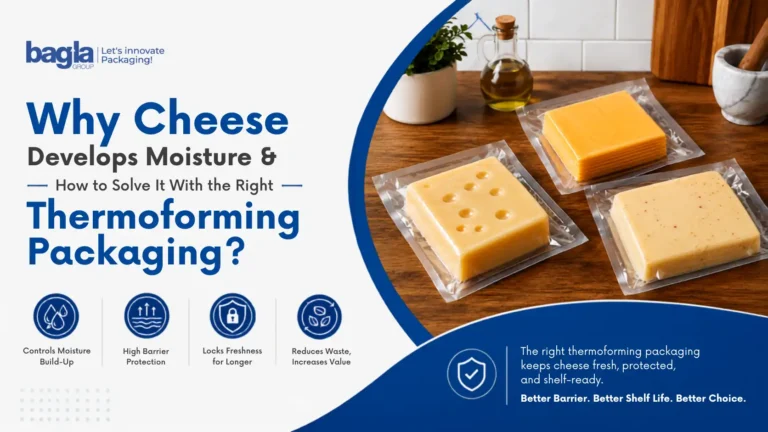
- Cheese and dairy portions.
- Ready-to-eat and ready-to-cook meals.
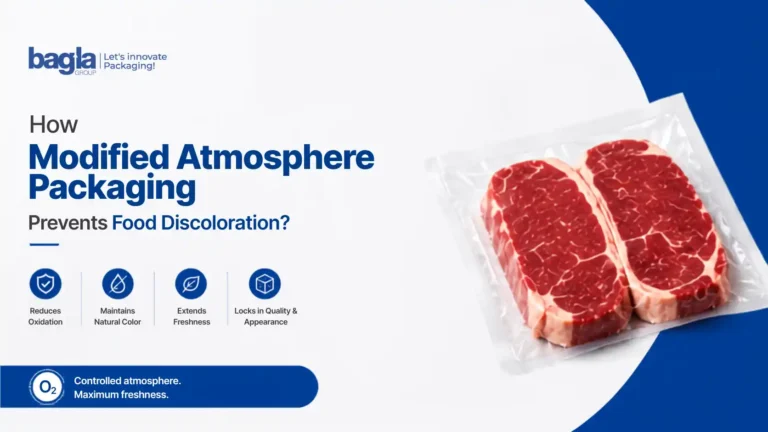
- Snacks and bakery items that need MAP (modified atmosphere packaging).
- Pet food and industrial components requiring protective packaging.
Anywhere a vacuum skin pack, MAP tray, or deep-drawn thermoformed pack shows up on a shelf, there’s a good chance a high barrier film is doing the heavy lifting underneath.
Why Barrier Performance Is Non-Negotiable in Flexible Packaging?
Shelf life isn’t a marketing number — it’s a supply chain number. A film with poor oxygen transmission rate (OTR) and water vapor transmission rate (WVTR) forces brands to compromise on distribution radius, retail dwell time, or product freshness guarantees. That has real financial consequences: more returns, more food waste, and more customer complaints.
A well-designed high barrier film pays for itself by:
- Extending shelf life without preservative overload
- Reducing food waste across the cold chain and on retail shelves
- Protecting brand reputation by preventing leakers, off-odors, and spoilage
- Enabling lighter, thinner packaging structures that still perform, cutting material and freight costs
This is exactly why procurement and packaging development teams increasingly treat barrier film selection as a strategic decision, not a commodity purchase.
Bagla Group’s QuenchTek HB: High Barrier Thermoforming Film For Flexible Packaging
This is where Bagla Group’s engineering comes in. QuenchTek HB is Bagla Group’s high barrier Thermoforming Film for flexible packaging, purpose-built for flexible packaging applications that have historically relied on multi-material laminates.
Rather than forcing customers to choose between barrier performance and recyclability, QuenchTek HB is engineered as a coextruded, PE-based structure that delivers high oxygen and moisture barrier properties while staying within a single recyclable polymer family. That single design decision changes what’s possible for brands running MAP, vacuum skin, or deep-draw thermoforming lines.
What Sets QuenchTek HB Apart
- High oxygen and moisture barrier: engineered to protect sensitive, perishable, and long-shelf-life products.
- Thermoforming compatibility: designed to run smoothly on standard deep-draw and thermoforming lines without requiring line modifications.
- Strong seal integrity: supports reliable, leak-resistant seals across MAP and vacuum pack formats.
- Downgauging potential: Designed structure can help brands reduce overall film weight without sacrificing protection.
- Regulatory alignment: supports compliance readiness with evolving EPR and recyclability mandates.
For food processors, dairy players, and meat and seafood packers who are under pressure from both retailers and regulators to move toward recyclable formats, QuenchTek HB offers a practical middle path: performance that doesn’t ask the brand to compromise on its sustainability roadmap.
You can review full technical specifications and application details on Bagla Group’s product page for QuenchTek HB.
How To Choose The Right High Barrier Thermoforming Film?
Choosing the right high barrier Thermoforming Film for flexible packaging depends on your product, packaging process, and shelf-life requirements. Here are the key factors to consider:
- Know Your Product: Different foods require different barrier levels. Fresh meat, seafood, cheese, and ready meals each have unique packaging needs.
- Choose the Right Barrier: Select a film with the appropriate oxygen and moisture barrier to maintain freshness and extend shelf life.
- Match Your Packaging Process: Ensure the film is suitable for vacuum packaging or Modified Atmosphere Packaging (MAP) and performs consistently on your packaging line.
- Check Mechanical Strength: Choose films with good puncture resistance, seal strength, and durability, especially for products with sharp edges.
- Select the Right Thickness: The ideal thickness should provide product protection while optimizing material usage and cost.
- Consider Sustainability: If sustainability is a priority, look for recycle-ready or mono-material packaging solutions that align with your packaging goals.
- Partner with a Reliable Manufacturer: Work with a supplier that offers consistent quality, technical support, and films designed for your specific application.
Why Partner With Bagla Group?
Bagla Group has spent years specializing in flexible packaging Thermoforming Films, working closely with converters and brand owners to solve exactly this kind of barrier-versus-recyclability trade-off. QuenchTek HB reflects that focus: a film engineered by people who understand both the physics of barrier performance and the practical realities of running a thermoforming line at commercial speed.
Final Thoughts
High barrier Thermoforming Film for flexible packaging sits at the intersection of food safety, cost efficiency, and environmental responsibility — three priorities that used to pull in different directions. Mono-material film construction has closed that gap, and products like Bagla Group’s QuenchTek HB show what’s possible when barrier engineering and recyclability are designed in together from the start, rather than negotiated after the fact.
If your team is evaluating a shift from multi-material laminates to a recyclable, high-performance alternative, it’s worth starting the conversation with a film built specifically for that transition. Explore the technical details of QuenchTek HB on Bagla Group’s product page, or reach out to Bagla Group’s team to discuss trials on your specific application.