If you’ve spent any time in the poultry supply chain, you already know the pain that bone-in cuts create at the packaging stage. A sharp rib tip or a jagged drumstick edge doesn’t care how good your film specs look on paper — if it punctures the pack, you’ve got a leaker, a returned pallet, and a retailer asking hard questions. For packaging distributors serving processors across the US, sourcing the right packaging solutions for bone chicken products isn’t optional anymore. It’s the difference between a customer who reorders and one who moves to a competitor.
This guide breaks down what’s actually working right now in packaging solutions for bone chicken products — from film to machine compatibility — and why the conversation has shifted so heavily toward purpose-built anti-puncture structures like Bagla Group’s QuenchTek BG, part of its Bone Guard Thermoforming Films range.
Why Bone-In Chicken Packaging Is Its Own Category?
Any discussion of packaging solutions for bone chicken products has to start here: bone-in cuts don’t behave like boneless ones on a packaging line. Boneless chicken breast, thighs, and tenders behave fairly predictably. Bone-in cuts — drumsticks, wings, split breasts, quarters, bone-in thighs, do not. The bone itself acts like a built-in stress point, and depending on how the bird was processed, it can be exposed, splintered, or protruding right where the film needs to seal.
A few things make bone-in poultry packaging genuinely harder to get right:
- Puncture risk during forming and transport. Bone tips can pierce standard films the moment vacuum is pulled, or later during palletizing, stacking, or distribution when packs shift against each other.
- Purge and drip control. Bone-in cuts tend to release more moisture, so the packaging needs to manage liquid without clouding visibility or compromising the seal.
- Shelf life expectations. Retailers want extended shelf life for bone-in SKUs just as much as for boneless ones, which means oxygen and moisture barrier properties can’t be an afterthought.
- Retail shelf appeal. Cloudy film, fogging, or discoloration on a bone-in tray kills sell-through fast, even if the product inside is perfectly fine.
- Cold chain durability. Bone-in packs often travel further and sit longer before reaching a shelf, so the film has to hold up through temperature swings without losing integrity.
This is exactly why generic barrier films fall short, and why smart packaging solutions for bone chicken products have moved toward films engineered specifically to resist bone puncture while still meeting food safety and shelf-life requirements.
The Core Packaging Formats Used for Bone-In Poultry
Before getting into film specifics, it’s worth mapping out the formats that make up most packaging solutions for bone chicken products on the market today, and which ones distributors are actually being asked for.
1. Vacuum Skin Packaging (VSP)
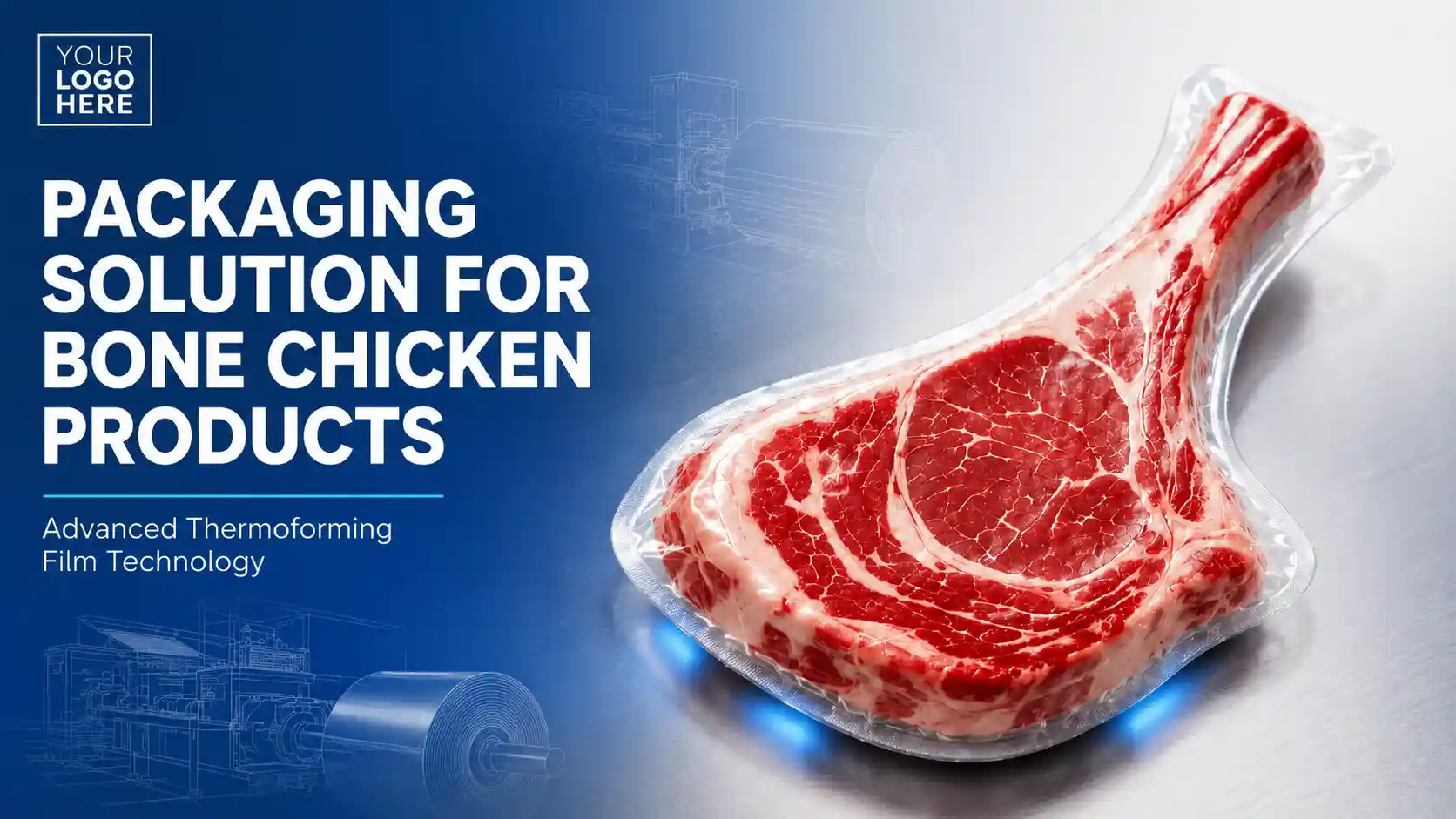
Vacuum skin packs mold the film tightly around the product, almost like a second skin. This format is one of the most popular packaging solutions for bone chicken products because it minimizes movement inside the pack; less movement means less chance of a bone shifting and puncturing the film during transit. VSP also gives a clean, high-visibility presentation that retailers like for case-ready poultry.
2. Modified Atmosphere Packaging (MAP)
MAP replaces the air inside the pack with a specific gas mixture, usually a blend of carbon dioxide and nitrogen, to slow bacterial growth and oxidation. Among packaging solutions for bone chicken products, MAP trays are typically paired with a rigid or semi-rigid base and a high-barrier lidding or thermoforming film to lock in that atmosphere without a seal failure.
3. Thermoformed Trays
Thermoforming uses heat and pressure to shape a base web into a tray, which is then filled and sealed with a top web. This format is widely used for bone-in retail packs because the tray can be engineered with reinforced corners and depth to keep bones away from the sealing area.
4. Flow Wrap and Overwrap
Less common for individually portioned cuts, but still used for family packs and foodservice bulk formats where cost efficiency matters more than shelf presentation.
Across all four formats, one variable determines success or failure more than any other: the film. It’s the film that ultimately decides whether packaging solutions for bone chicken products hold up in the real world, not just in a spec sheet.
Bone Guard Thermoforming Films: The Purpose-Built Answer
This is where Bone Guard Thermoforming Films come into the picture, and where most modern packaging solutions for bone chicken products really start. Unlike standard barrier films that are built primarily around oxygen transmission rate (OTR) and clarity, this category of film — and Bagla Group’s QuenchTek BG in particular — is engineered from the ground up to resist puncture from sharp, irregular bone surfaces, without sacrificing the barrier and sealing performance processors depend on. Here’s what typically sets Bone Guard Thermoforming Films like QuenchTek BG apart from a conventional structure:
- Thicker film structure: Bone Guard Thermoforming Films are typically thicker than conventional thermoforming films, providing extra protection against sharp bone edges and helping reduce punctures and package failures.
- Multilayer, co-extruded construction: Rather than relying on a single resin layer for strength, films like QuenchTek BG combine multiple polymer layers — each contributing a specific property. One layer might be responsible for puncture and tear resistance, another for oxygen barrier, and another for seal integrity against contaminated surfaces (a real concern with bone-in cuts, since fat, moisture, and bone fragments can interfere with sealing).
- High puncture and abrasion resistance: The defining feature. These films are formulated to withstand the mechanical stress of sharp bone tips during forming, filling, stacking, and transit, dramatically reducing leaker rates compared to standard thermoforming webs.
- Strong oxygen and moisture barrier: Even with reinforced puncture resistance, the film still needs to deliver a low OTR to protect color and extend shelf life. Bone-in poultry is just as susceptible to oxidative discoloration as boneless cuts, so barrier performance can’t be compromised for toughness.
- Seal integrity through contamination: Bone-in packaging lines inevitably deal with some grease, purge, and moisture at the seal area. A well-formulated film such as QuenchTek BG is designed to seal reliably even when the sealing surface isn’t perfectly clean — something standard films often struggle with.
- Optical clarity and anti-fog properties. Because retail presentation matters, these films are also built to stay clear and resist fogging under refrigerated display, so the product stays visible on the shelf.
- Compatibility with existing thermoforming lines. A major practical advantage for distributors selling packaging solutions for bone chicken products: films in this category are typically designed as drop-in replacements for standard thermoforming webs, meaning processors don’t need to invest in new equipment to adopt them. That’s a key selling point when you’re pitching an upgrade to a customer who’s cautious about capital expenditure.
Why QuenchTek BG Stands Out?
Among the Bone Guard Thermoforming Films distributors bringing to processors this year, QuenchTek BG from Bagla Group has become a go-to reference point. It features a thicker film structure than conventional thermoforming films, helping it withstand the puncture stress created by bone-in chicken without compromising barrier performance, clarity, or seal reliability. Designed to run on existing thermoforming equipment, it gives processors a simple upgrade without requiring new machinery. That combination makes it an easy product to recommend and sets it apart from general-purpose films marketed for bone-in applications.
What Distributors Should Evaluate When Sourcing Bone-In Packaging Films?
If you’re advising processors on packaging solutions for bone chicken products, here’s a practical checklist worth running through with every film supplier before you recommend a switch. It’s also a useful way to see why QuenchTek BG tends to hold up well against the competition:
- Film thickness: Check whether the film is thicker than conventional thermoforming films, as the added thickness helps improve puncture resistance for bone-in products.
- Puncture resistance data: Ask for actual test results, not just marketing language.
- OTR and WVTR specs: These numbers directly affect shelf life claims; get them in writing and match them against your customer’s targets.
- Sealing performance under real conditions: Ask whether the film has been tested for sealing through fat, moisture, and bone fragment contamination — not just on a clean surface.
- Line compatibility: Confirm the film works with your customer’s existing thermoformer, sealing temperatures, and line speeds.
- Regulatory compliance: Confirm food-contact compliance (FDA regulations in the US) and any certifications relevant to export markets.
- Sustainability profile: More processors and retailers are asking about recyclability and reduced plastic usage. Films with mono-material structures or reduced-thickness engineering are increasingly part of the conversation, even in a category of packaging solutions for bone chicken products where performance has traditionally trumped everything else.
- Consistency across batches: Puncture resistance and clarity should hold steady roll to roll — inconsistent film performance means inconsistent leaker rates, which is exactly what reliable packaging solutions for bone chicken products are supposed to eliminate.
Why This Matters More In 2026 Than It Did a Few Years Ago?
A few industry shifts have pushed packaging solutions for bone chicken products higher up the priority list for processors and distributors alike:
- Retailer pressure on shrink and returns: Leaker rates directly affect a retailer’s shrink numbers, and that cost pressure keeps getting pushed back onto processors — and then onto packaging suppliers.
- Rising demand for bone-in cuts: Bone-in chicken has seen renewed demand in the US, driven by value-conscious consumers and flavor preference trends across retail and foodservice.
- Extended distribution distances: Consolidation in poultry processing means product often travels farther from plant to shelf, putting more stress on packaging integrity over longer transit times.
- Sustainability requirements without compromising performance: Processors want to reduce plastic usage, but not at the cost of higher leaker rates — which makes engineered, high-performance films more valuable, not less.
None of these pressures are going away. If anything, they’re intensifying, which is exactly why purpose-built solutions like Bone Guard Thermoforming Films — QuenchTek BG among them — have moved from a niche upgrade to a near-standard expectation for bone-in retail packs.
Positioning This for Your Customers
If you’re a distributor talking to processors about upgrading their packaging solutions for bone chicken products, the strongest pitch isn’t about the film in isolation — it’s about the total cost of leakers. A processor running standard film might be absorbing leaker-related returns, retailer chargebacks, and brand damage that far outweigh the marginal cost difference of switching to a film like QuenchTek BG. Framing the conversation around total cost of ownership, rather than price per roll, tends to land much better with buyers who are otherwise hesitant to change a film they’ve used for years.
It also helps to walk customers through compatibility first: since QuenchTek BG and other Bone Guard Thermoforming Films run on existing thermoforming equipment, the barrier to switching is lower than processors often assume — which removes one of the biggest objections before it even comes up.
Conclusion
Packaging solutions for bone chicken products have moved well past “just use a slightly thicker film.” Processors need structures that are engineered specifically to handle the mechanical stress bones create, while still delivering the barrier performance, seal integrity, and shelf appeal that boneless packaging has long taken for granted. Bone Guard Thermoforming Films represent exactly that kind of purpose-built solution — combining puncture resistance, strong oxygen and moisture barriers, reliable sealing under real-world contamination, and compatibility with existing production lines. QuenchTek BG from Bagla Group is one of the clearest examples of this category done right, and it’s worth putting in front of any processor still dealing with bone puncture complaints.
For distributors, understanding these technical details isn’t just useful background — it’s what lets you have a credible, consultative conversation with processors who are trying to cut leaker rates, protect shelf life, and keep their retail customers happy. Getting the film right at the packaging stage isn’t a small operational detail. For bone-in poultry, well-chosen packaging solutions for bone chicken products — QuenchTek BG included — are often the single biggest lever available for reducing waste and protecting margin across the entire supply chain.
If you’re evaluating options for your own portfolio, get in touch with Bagla Group to request samples and technical data sheets for QuenchTek BG and the wider Bone Guard Thermoforming Films range.