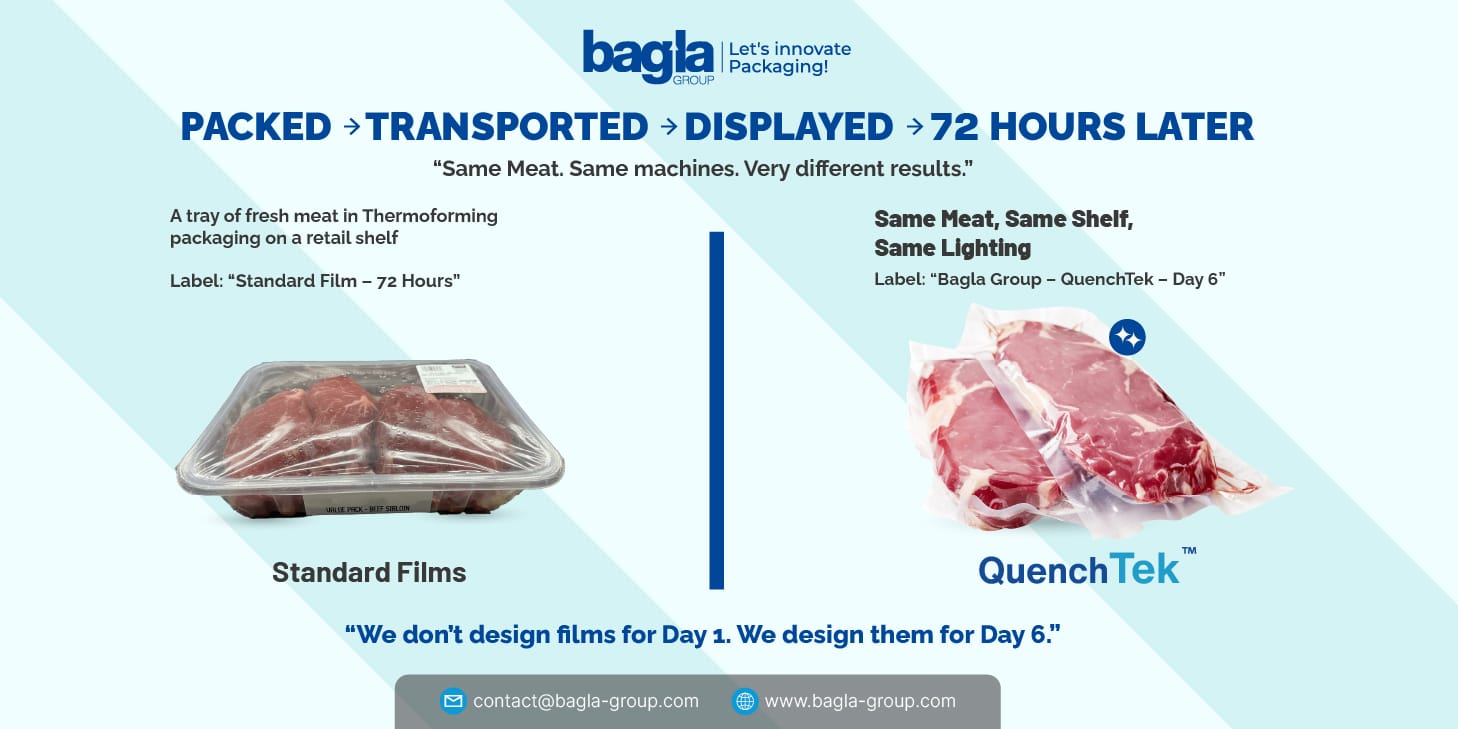
A large poultry processor in Europe had a recurring problem. The chicken looked perfect when it left the packaging line. But 72 hours later, on the retail shelf, the packs lost their premium appeal.
The Symptoms They Started Seeing Within 72 Hours
A closer review revealed several recurring issues, such as:
- Slight haze developing on the film.
- Micro-leaks appear after transport.
- Product still safe, but not “fresh-looking.”
- Retailers are pushing back, and margins are shrinking.
What all did the Poultry Processor try?
Every solution they tried added cost, without solving the real issue. They experimented with:
- Thicker films: Higher cost, same problem.
- Cheaper films: More complaints.
- Imported films: Long lead times and zero flexibility.
Nothing addressed how the film actually behaved under real-world stress.
The Turning Point: Shifting From Cost to Performance
Instead of asking: “What’s the cheapest film?” They finally asked: “What film performs reliably under stress?”
Stress in their environment meant:
- Hot filling followed by rapid cooling.
- High-speed forming cycles.
- Deep-draw thermoforming cavities.
- Cold-chain logistics.
- Long display periods under retail lighting.
That’s when they found out about Bagla Group’s Water-Quenched Thermoforming Films, and thought to give it a shot!
Bagla Group’s Solution: QuenchTek – Water-Quenched Thermoforming Film
Bagla Group supplied a customized thermoforming structure designed specifically for:
- Clarity
- Seal integrity
- Gauge uniformity
- Forming consistency.
Difference They Started Noticing
With the new Thermoforming Films, the processor experienced:
- Instant Melt Cooling: Tighter molecular structure.
- Improved Gauge Uniformity: Fewer weak spots.
- Superior Clarity: The product still looked fresh on Day 6.
- Consistent Seal Strength: Fewer line rejects.
Same product, Same machines, completely different shelf performance.
Results That Directly Impacted The Bottom Line
The win wasn’t because the film was:
- Thicker,
- Cheaper,
- Or more complicated than needed.
They won because:
- Retail complaints dropped significantly.
- Line stoppages reduced.
- Shelf performance became predictable.
- Brand perception improved across stores.
For the first time, packaging stopped being a risk and started behaving like an asset.
Why This Approach Delivered Better Performance?
Bagla Group’s Water-Quenched Thermoforming Films delivered:
- Stable gauge control.
- Reliable forming across SKUs.
- Strong, consistent seals.
- Crystal-clear product visibility.
“Anyone can make a film that looks good on Day 1. We design films that behave on Day 6.”
Key Takeaways
This case proves that success in food packaging isn’t about chasing the lowest price. It’s about:
- Confidence at high production speeds.
- Predictable shelf appearance.
- Fewer line interruptions.
- Better-looking food without added downstream cost.
Bagla Group becomes the silent partner between production and the shelf, ensuring quality, consistency, and performance.